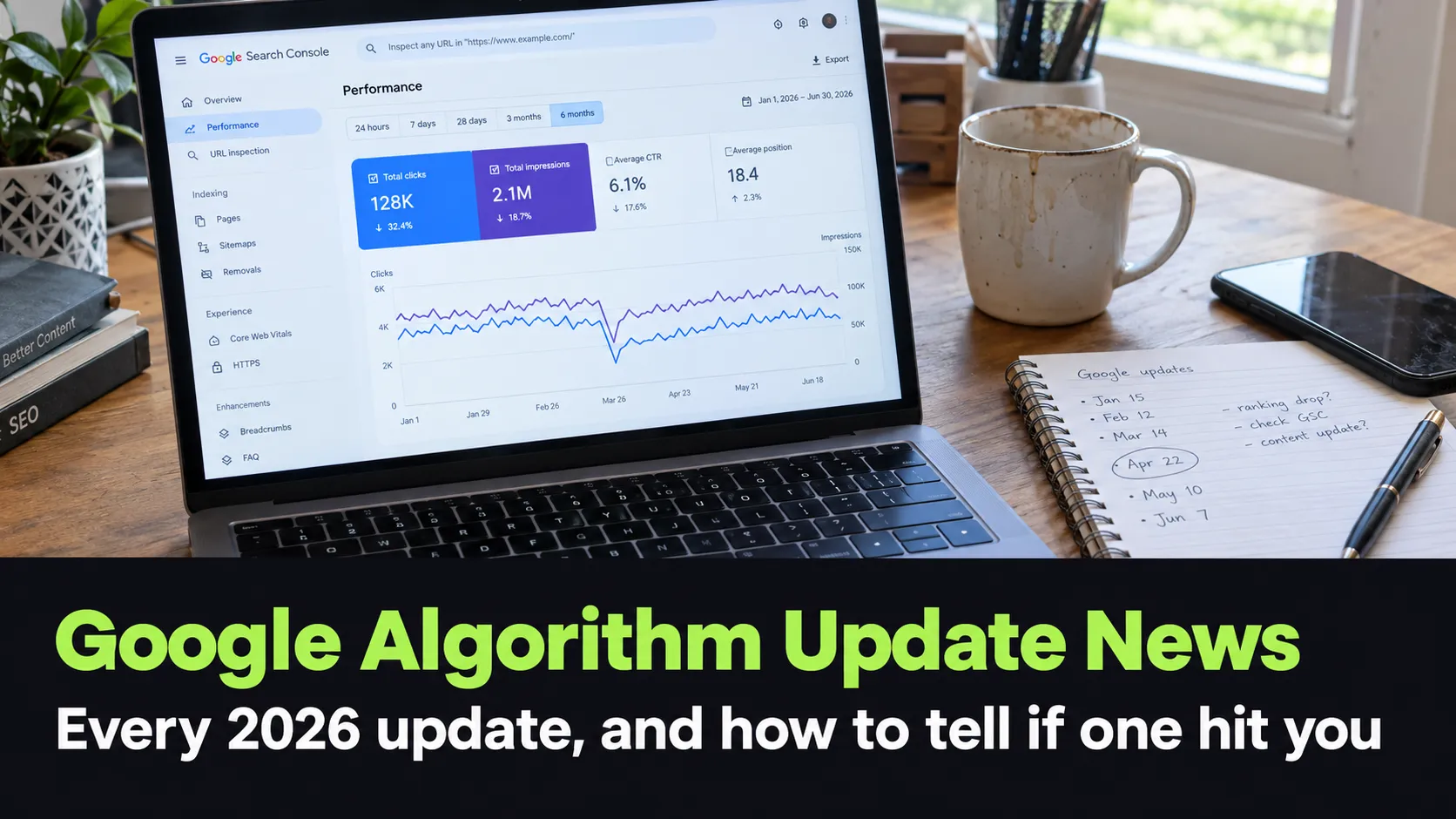
Your clicks fell sometime in the last fortnight and you are trying to work out whether Google did something or you did. That is the right question, and it has a checkable answer. If you are looking for Google algorithm update news because your Search Console graph just bent downwards, start with dates, not theories.
Below is every confirmed update Google has released in 2026, what is rolling out right now, and the process I use to decide whether an update is actually responsible for a drop. In most cases I look at, it is not.
What is rolling out right now: the September 2026 spam update
Google released the September 2026 spam update on 24 September at 09:15 Pacific time. According to the Google Search Status Dashboard, it applies globally and to all languages, and the rollout may take up to two weeks to complete. Used in full, that window closes around 8 October.
What we know about it is short:
- It is the fourth spam update of 2026, after March, June and August.
- It is the first spam update this year with a two week window. The previous three each finished in roughly two to three days.
- Google called it a normal spam update. No new policy came with it, and no specific spam type was named as the target.
- It is not a link spam update, per Google’s own description reported by Search Engine Roundtable.
That last point matters. If you were hit, disavowing links is unlikely to be the fix.
Every confirmed Google update in 2026
Google has confirmed seven ranking updates so far this year. Here is the full list from the dashboard.
| Update | Started | Finished | Type |
|---|---|---|---|
| February 2026 Discover core update | 5 February | 27 February | Discover only, US first |
| March 2026 spam update | 24 March | 25 March | Spam |
| March 2026 core update | 27 March | 8 April | Broad core |
| May 2026 core update | 21 May | 2 June | Broad core |
| June 2026 spam update | 24 June | 26 June | Spam |
| August 2026 spam update | 18 August | 21 August | Spam |
| September 2026 spam update | 24 September | In progress | Spam |
Two things stand out. Four spam updates in one year is unusual, given that 2025 had only one. And the February Discover update was the first core update Google has ever aimed at Discover alone, so a drop in Discover traffic around that window may have nothing to do with web search rankings at all.
Spam update or core update: the difference decides your fix
People use “algorithm update” for both. They behave very differently, and the right response to one is wrong for the other.
A core update is Google reassessing how relevant and satisfying pages are across the web. It is not a penalty. Google’s position is that a site losing rankings after a core update has not necessarily done anything wrong. Other pages simply got judged as better answers.
A spam update is an improvement to SpamBrain, Google’s automated spam detection system. It enforces Google’s published spam policies. If a spam update hit you, there is usually something specific on the site that falls foul of a policy.
So the first question is not “how do I recover”. It is “which kind of update lines up with my drop, if any”.
- Tracking change
- Site deploy or migration
- Indexing issue
- Seasonality
How I check whether an update actually caused your drop
This is where most of the wasted effort happens. Somebody sees a drop, reads Google algorithm update news the same day, and assumes the two are connected. In the drops I am asked to diagnose, the update gets blamed far more often than it turns out to be the cause. A deploy, a tracking change, or plain seasonality is more common.
Here is the order I work in:
- Match exact dates. Open Search Console, set the date range to cover the drop, and compare the first day of decline against the table above. A drop that started four days before an update began did not come from that update.
- Check whether it is site wide or isolated. A core update tends to move whole sections or page types. A drop in three URLs usually points to something on those pages.
- Rule out your own changes. Theme updates, plugin updates, migrations, robots.txt edits, and new canonical rules all produce drops that look exactly like an algorithm hit. I keep an SEO technical audit checklist for precisely this step.
- Compare against last year. If the same dip happened in the same weeks last year, you are looking at demand, not rankings.
- Wait for the rollout to finish. Google recommends leaving at least a full week after an update completes before drawing conclusions from Search Console. Rankings bounce during a rollout.
Muhammad is an excellent SEO Expert. He totally understands SEO inside out and delivers results that actually make a difference. Communication was easy, and he always kept me updated on progress.
Melissa Gerhold, client feedback
If a core update hit you
The honest answer is uncomfortable: there is no specific fix to apply. Google says recovery can happen between core updates, but the largest changes usually arrive with the next core update, because that is when your pages get reassessed.
That does not mean waiting idle. It means spending the time on the pages that lost the most, and asking hard questions about them:
- Does the page answer the query better than what now outranks it? Read the pages above you, properly.
- Is the information current? Out of date figures and expired advice are common on pages that slid.
- Would a reader trust who wrote it? Thin bylines and no visible experience are a real weakness here.
On timing, the last core update finished on 2 June, so the gap is now long. Google has run a core update in November or December in every year since 2020 apart from 2022, which makes another one before the end of 2026 likely. Treat that as a pattern, not a promise. Google has not announced anything.
If your traffic is down and you cannot match it to anything above, it is worth reading why SEO stops working before you change anything.
If a spam update hit you
Spam updates leave something to look for, which makes them easier to diagnose and slower to recover from.
Start with Google’s spam policies and audit the site against them honestly. The common culprits are scaled content produced mainly to rank, doorway pages built for every city or keyword variation, hidden text, and hosting third party content that has nothing to do with your site’s purpose.
Two things to know before you start:
- Recovery is slow. Google says it can take many months after you fix the issue, because its systems need time to observe the change.
- Fixing is not optional. Unlike a core update, there is a real problem to remove. Waiting for the next update without fixing it will not help.
If the audit turns up something you are not sure how to unwind safely, that cleanup is most of what my SEO recovery work involves.
Where to get Google algorithm update news first
You do not need to follow a dozen newsletters. Three sources cover almost everything:
- The Google Search Status Dashboard is the official record. Every core and spam update gets an entry with a start time and, eventually, an end time.
- Google Search Central on LinkedIn and X posts the same announcement within minutes.
- Search Engine Journal and Search Engine Roundtable report each release fast and track rollout completion.
Bookmark the dashboard. When traffic drops, it is the first page I open.
FAQ
What is the new Google algorithm update?
The September 2026 spam update, released on 24 September with a rollout window of up to two weeks. It is the fourth spam update this year. Google described it as a normal spam update, named no specific target, and confirmed it is not a link spam update. The most recent core update was the May 2026 core update, which finished on 2 June.
Did Google release a core update today?
Check the Google Search Status Dashboard, which lists every confirmed core and spam update with its start date. As of early October 2026 the latest core update was May’s. Industry watchers expect another before the year ends based on past patterns, but Google has not announced one. Treat any claim of a new core update with caution until it appears on the dashboard.
How often does Google update its algorithms?
Constantly, in small ways that go unannounced. Confirmed updates are rarer. Google has confirmed seven so far in 2026: one Discover core update, two broad core updates and four spam updates. Most years see between three and four broad core updates, though 2026 has had fewer core updates and more spam updates than usual.
Is SEO dead now with AI?
No, but it has changed. AI Overviews and AI Mode pull from pages Google already indexes and ranks, so a site that is invisible in normal search is usually invisible in AI answers too. What has changed is that ranking alone earns fewer clicks, so being clearly cited, accurate and easy to quote matters more than it did.
Not sure whether an update hit you?
If your traffic fell and you cannot tell whether it was Google, your site, or demand, that is a diagnosis problem, and it is cheaper to solve before you start rewriting pages.
Send me your domain and the date the drop started. I will pull your Search Console data myself, line it up against every confirmed update, and within three business days send you a short written answer: whether an update is the likely cause, which pages took the hit, and the first three things I would check. No call required.