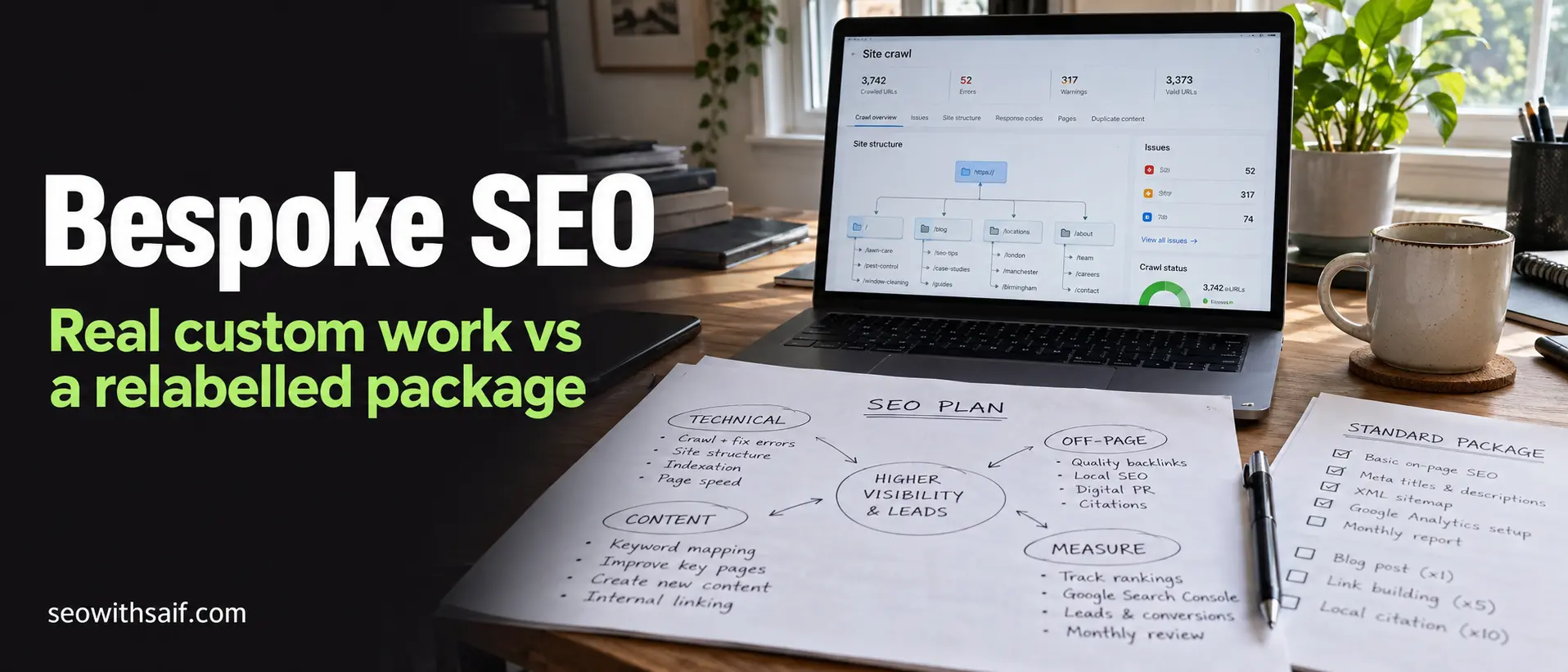
The proposal said “bespoke”. The first month’s report says something else. It lists the same twelve tasks your friend’s bakery gets from the same agency: a few title tag edits, two blog posts, a handful of directory links and a rankings chart for keywords you never asked about. Three months in, nothing about the work reflects your business, your customers or the specific problems on your website.
That is the most common complaint I hear from owners who paid for bespoke SEO services. The word has become a sales label. Almost every agency uses it, and very few can show you what is actually custom about the work. In this guide I will explain what genuinely tailored SEO involves, how to tell it apart from a template with your logo on it, what it costs, and when you do not need it at all.
What bespoke SEO actually means
Bespoke SEO is search optimisation planned from a diagnosis of your specific site, market and goals, rather than from a fixed list of monthly tasks. The plan, the order of the work and the way success is measured all come out of what the research finds.
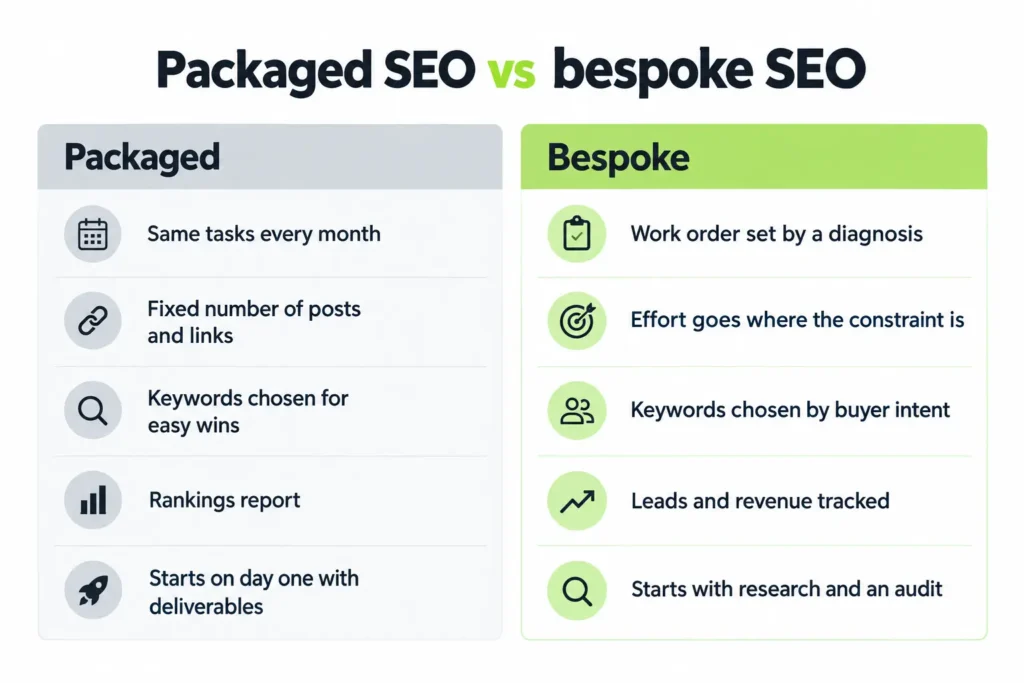
The simplest test is this: in a real bespoke engagement, two clients in different industries would receive noticeably different work in their first 90 days. In a packaged service, they receive the same deliverables in the same order, with only the keywords swapped.
That difference matters because the reasons sites fail to rank are not evenly spread. One business has a crawl problem hiding half its pages from Google. Another has strong pages that target the wrong search intent. A third has a clean site and good content, but no authority in its niche. A fixed package treats all three the same way, which means at least two of them are paying for work that does not address their real constraint.
The scale of the problem is easy to underestimate. When Ahrefs studied around 14 billion pages in its search traffic study, it found that 96.55% of pages get no traffic from Google at all. Publishing more pages on a schedule, which is what most packages sell, does not move a site out of that group. Fixing the specific reason its pages are not ranking does.
Signs you are being sold a relabelled package
A lot of providers that call themselves a bespoke SEO agency are selling tiers with a custom-sounding name. These are the warning signs I look for when a client shows me a proposal.
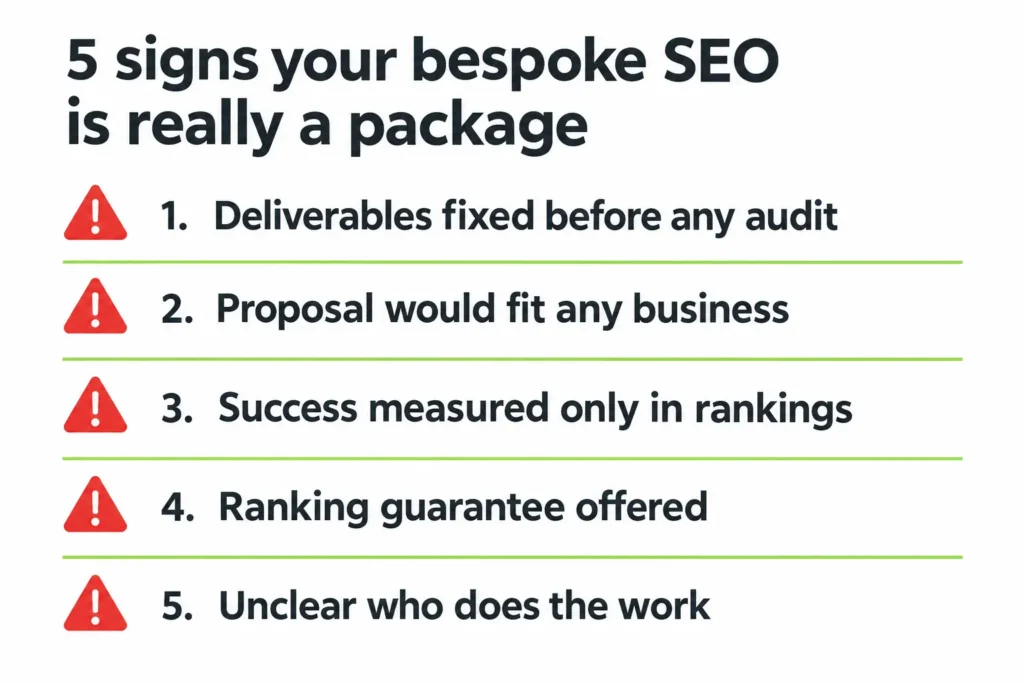
The deliverables are fixed before anyone has looked at your site. If the proposal already says “4 blog posts and 10 backlinks per month” before an audit has happened, the plan was not built for you.
The proposal could be sent to any business. Swap your company name for a competitor’s and see whether anything else would need to change. If not, it is a template.
Success is measured only in rankings. Rankings for terms the provider picked are easy to report and easy to inflate. Real tailored SEO is measured in calls, enquiries, sales or sign-ups.
There is a ranking guarantee. Google’s own guidance on whether you need an SEO states plainly that no one can guarantee a number one position. Guarantees usually mean the provider has chosen easy keywords that nobody searches, so they can hit the target.
The same person sold it and nobody explains who does the work. In larger agencies the strategist you met on the sales call often hands you to a junior account team running a standard process.
None of these make a provider dishonest by default. Packages can be good value for very small, simple sites. The issue is paying a bespoke price for packaged work.
What a genuinely bespoke SEO strategy includes
Real custom work still covers the familiar parts of SEO. What changes is how much effort each part gets, and in what order. A proper bespoke engagement should include the following.
A diagnosis before any plan. That means a crawl of the whole site, a look at how Google is indexing it, a review of what is already ranking and converting, and a study of the competitors who hold the positions you want. These are the checks I run on every new site before I recommend anything.
A priority order, with reasons. The output of the diagnosis is a ranked list: what is capping growth most, what to fix first, and what to leave alone for now. If the biggest issue is technical, the early months go into crawl and indexing fixes, not into new blog posts.
Keyword targeting based on buyer intent. Tailored keyword research starts from what your customers actually search before they buy, not from the highest-volume terms in your industry. For many businesses the best opportunities are low-volume, high-intent searches a package would never prioritise.
Content planned around real questions. Instead of a quota of posts, you get a content plan built around buyer questions and the pages that should exist on your site but do not yet.
Authority work that fits your niche. Links and mentions should come from sources your customers and your industry actually read. Bulk directory submissions are the opposite of bespoke. Good link and mention building looks different for a SaaS product, a dental practice and an online shop.
Visibility in AI answers. More buyers now ask ChatGPT, Gemini or Google’s AI Overviews who to hire or what to buy. A current strategy should cover how brands get cited by AI assistants alongside traditional rankings.
Reporting tied to business results. Leads, revenue or sign-ups, with rankings and traffic shown as supporting evidence rather than the headline.
How tailored SEO differs by business type
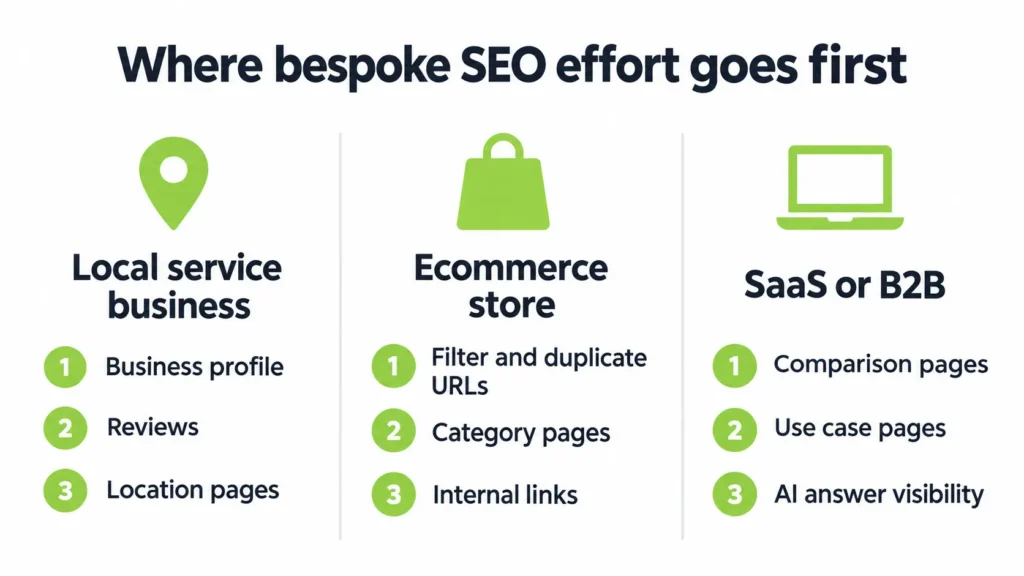
The best way to see what “bespoke” should mean is to compare how the same budget gets spent on three different sites.
| Business type | Where the effort usually goes first | What a package would get wrong |
|---|---|---|
| Local service business | Google Business Profile, reviews, location and service pages, call tracking | Publishing generic blog posts that never show in the map pack |
| Ecommerce store | Faceted navigation, duplicate product URLs, category page content, internal links | Writing blog content while thousands of filter URLs waste crawl budget |
| SaaS or B2B company | Comparison and alternative pages, use case pages, product-led content, AI visibility | Chasing broad, high-volume terms that bring traffic but no sign-ups |
For local businesses, the priority is usually map pack and profile work for service businesses. For stores on complex platforms, it is often technical, which is why I offer store-level work on Magento builds as its own service. For SaaS, it is usually intent and positioning. A plan that looks the same across all three is not tailored to any of them.
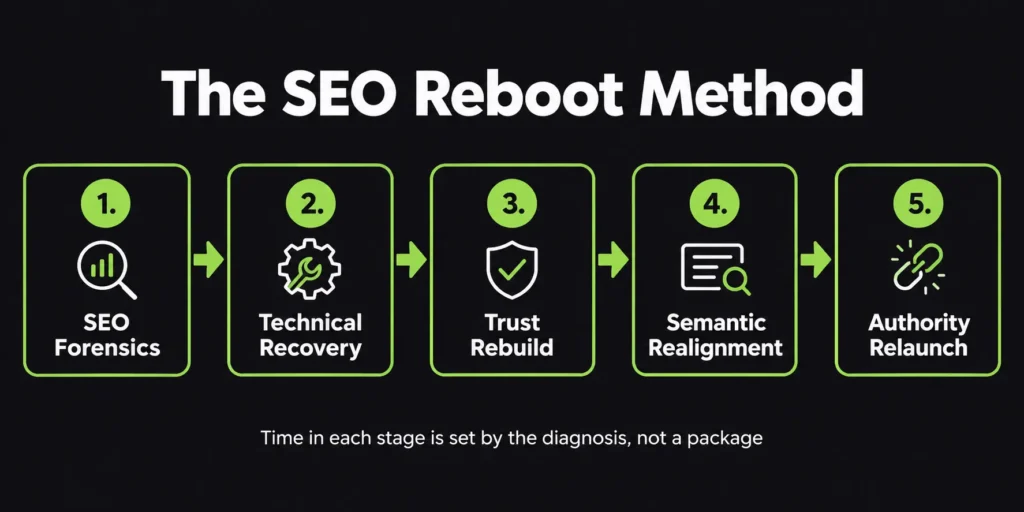
How I build a bespoke plan: the SEO Reboot Method
I use the same five-stage framework on every project, but the time spent in each stage depends entirely on what the diagnosis finds. That is the honest version of bespoke: a consistent method, applied differently to every site.
- SEO Forensics. Find the hidden issues standard audits skip, such as crawl waste, index bloat, keyword cannibalisation and tracking gaps. The output is a ranked list of what is actually capping growth.
- Technical Recovery. Fix crawl, speed, indexing and structural blockers before touching content.
- Trust Rebuild. Restore the signals search engines and users rely on: entity clarity, schema, reviews and consistency.
- Semantic Realignment. Rebuild pages around real search intent instead of keyword lists.
- Authority Relaunch. Content, links and mentions that compound, including the sources AI assistants use to recommend brands.
For one client the first two stages take a fortnight because the site is technically clean. For another, a site that lost traffic after a core update, diagnosing the traffic drop and fixing the structure can take most of the first quarter. Same method, very different plans.
What bespoke SEO services cost
Custom work usually costs more per month than an entry-level package, because it starts with research and needs senior time rather than a fixed production line. As a rough guide, tailored SEO for a small business typically starts somewhere between $500 and $1,500 a month, while competitive markets, larger ecommerce stores and SaaS products commonly sit between $1,500 and $5,000 or more.
The figure on its own tells you little. What matters is what work sits behind it and whether that work targets your real constraint. I broke down what SEO typically costs in 2026 in a separate guide, including retainers, hourly rates and project pricing.
For my own work, my hourly rate sits between $25 and $49 an hour and most projects start from $1,000. Because I work independently, there is no account management layer between you and the person doing the work, and most engagements begin with a diagnosis so you can see the plan before committing to anything ongoing.
When you do not need bespoke SEO
Not every business needs a fully custom engagement, and I would rather say so than sell one.
If you run a single-location business in a small town with little competition, a well-run standard local package or a few hours of guidance to set up your profile and pages properly may be all you need. If your site is brand new with almost no content, there is not yet much to diagnose, and a solid foundation matters more than a custom strategy.
Bespoke work pays off when something specific is holding you back and nobody has found it: traffic that dropped and never returned, rankings stuck on page two for months, a large or complex site, or a competitive market where generic tactics stopped working long ago. If that sounds familiar, the usual reasons SEO stalls are worth reading before you hire anyone. And if you are still weighing up who to hire, I have also written about choosing between an agency and an independent specialist.
Questions to ask any provider offering bespoke SEO
- What will you need to look at before you can tell me what the plan is?
- How would my first 90 days differ from your last client’s?
- How did you decide which keywords to target, and why those?
- Who will actually do the work, and will I speak to them directly?
- How will we measure success beyond rankings?
- What would make you recommend I do not hire you?
The last question is the most revealing. A provider doing genuine tailored work will have a clear answer. A provider selling a package usually will not.
Frequently asked questions about bespoke SEO
What does bespoke mean in marketing?
Bespoke means made to order for one specific client, borrowed from tailoring, where a bespoke suit is cut from a pattern made for one person. In marketing and SEO it should mean a plan built from research into your business, rather than a pre-set package adjusted with your name and keywords.
What is the difference between bespoke SEO and standard SEO packages?
A standard package delivers a fixed set of tasks every month regardless of your site’s condition. Bespoke SEO starts with a diagnosis and puts effort wherever the biggest constraint is, so the work, its order and how success is measured all vary from client to client.
How much does it cost to hire someone to do SEO?
Most legitimate SEO work for small and mid-sized businesses costs between $500 and $5,000 a month, with hourly rates typically between $75 and $150. Custom engagements tend to sit in the middle or upper part of that range because they require research and senior time.
Can ChatGPT do SEO for me?
AI tools are useful for drafting content, generating ideas and speeding up analysis. They cannot crawl your site, see your Search Console data, judge your competitors’ real strengths, or decide what your business should prioritise. They are a helpful assistant to a strategy, not a replacement for one.
Can I do SEO on my own?
Yes, particularly for a small local business with modest competition. Many owners manage their profile, reviews and basic page updates themselves. Professional help is worth paying for when the site has technical problems, the market is competitive, or you have tried the basics and growth has stalled.
Is SEO being phased out by AI?
No, but it is changing. AI Overviews and assistants still draw on websites that are crawlable, well structured and trusted, so the fundamentals matter as much as ever. What has changed is that a good strategy now has to cover visibility in AI answers as well as traditional rankings.
How long does bespoke SEO take to show results?
Technical fixes can show results within weeks. Content and authority work usually takes six to twelve months to reach its full effect. A good provider should give you a realistic timeline based on your diagnosis, not a standard promise.
What clients say
“Muhammad is very talented person and knows his stuff. He found issues that many people missed.”
Zack Oughriss, Business owner
“Muhammad delivered excellent work on this SEO and optimization project, and I truly enjoyed working with him. Over the course of our 8-month collaboration, his strategies led to over 400% increase in customer leads – helping us outperform even larger competitors in our saturated industry.”
Alessio Ligabue, Services Provider (Italy)
“Working with Muhammad and his team has been a key driver in obtaining new leads for our B2B SaaS product. I am extremely happy with his SEO expertise and content writing, and would highly recommend him. For founders looking for a solid GTM strategy or continuing service, Muhammad is your guy!!!”
Brandon Parham, Cleri (USA)
Find out what your site actually needs
Before you pay for another package, find out what is really holding your site back. In a free 1:1 strategy call, I will look at your site and your market, tell you what I would work on first and why, and give you an honest view of whether you need custom work at all.