
You hired someone to do your SEO. Every month an invoice arrives, and with it a PDF full of charts. Six months in, the enquiries look the same as before, and when you ask what was actually done, the answer is vague: “ongoing optimisation”, “link building”, “content improvements”.
That is the experience most business owners describe when they start looking for a freelance SEO expert in the UK for the second time. The first hire was not necessarily dishonest. It was usually unclear: no agreed problem, no agreed fix, and no way to tell whether the money was working.
In this guide I will explain what a good freelancer actually does, what UK day rates look like in 2026, the questions that separate real specialists from resellers, and what to agree in writing before anyone touches your site.
What a freelance SEO expert actually does (and what they do not)
A freelance SEO expert is one person, working for themselves, who finds out why your site is not getting the search traffic it should and fixes it or tells you exactly how. That is the job. Everything else is detail.
In practice the work falls into four areas:
- Technical problems. Pages Google cannot crawl or index, slow templates, broken redirects, duplicate pages competing with each other. This is often where the biggest wins hide, and it is the area I work in most, through crawl, indexing and site structure work.
- Page-level problems. Service and product pages that do not match what customers search for, weak titles, thin copy. Good page-level fixes are usually quick to make and quick to show results.
- Authority. Whether other sites mention and link to yours. A specialist should be able to explain how they would go about earning links the honest way, not hand you a package of 50 links a month.
- Local visibility. For businesses that serve customers in a town or region, the Business Profile and map results. That is a separate skill set, and map and Business Profile work needs different checks from a national site.
What a single freelancer usually does not do is produce large volumes of content, run your paid ads, rebuild your website or manage your social media. Some do, but someone offering all of it alone is spreading thin. Ask which of these they do themselves and which they pass on to someone else.
The freelance market is large. IPSE puts the UK’s freelance workforce at roughly 2.05 million people, and SEO is one of the most crowded corners of it. That is good for choice and bad for quality control, which is why most of this guide is about checking.
Freelancer, agency or in-house: which fits your business
Before you compare freelancers, decide whether a freelancer is the right shape of help at all.
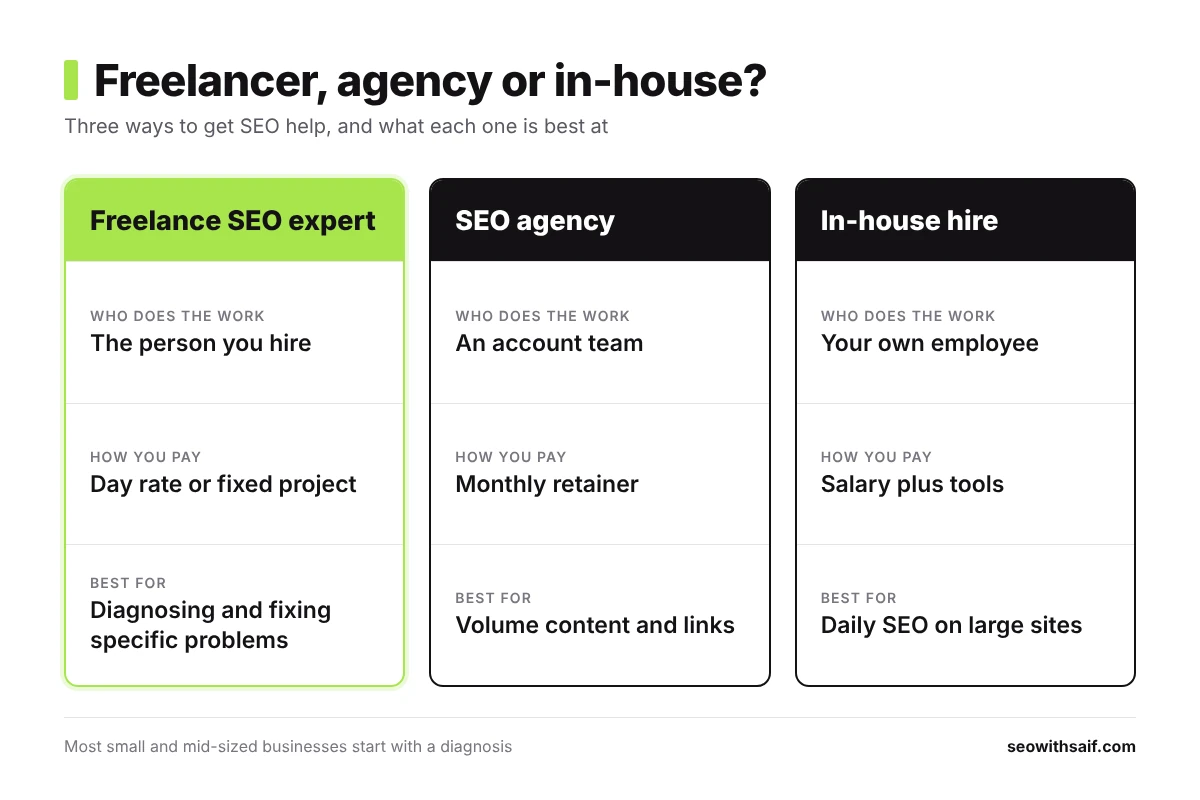
| Freelance SEO expert | SEO agency | In-house hire | |
|---|---|---|---|
| Who does the work | The person you hire | An account team, often with junior staff | Your own employee |
| Typical cost | Day rate or fixed project price | Monthly retainer, often with a minimum term | Salary plus tools, training and management |
| Speed to start | Days | Weeks, after onboarding | Months, after recruitment |
| Best for | Diagnosing and fixing specific problems, focused projects | Large sites needing content, links and reporting at volume | Big sites where SEO is part of daily operations |
| Main risk | One person’s capacity and availability | Paying for process rather than progress | A single hire who does not know what they do not know |
For most small and mid-sized UK businesses, the honest answer is that the first job is a diagnosis. Something is holding the site back, and one experienced person can usually find it faster than a team can be briefed. If the fix then needs volume, such as hundreds of product descriptions or a large content plan, an agency or an extra pair of hands may come later.
I have covered the agency versus freelancer decision in more detail in a separate post if you are still weighing the two.
What a freelance SEO expert in the UK costs
Freelance SEO in the UK is usually priced by the day, by the hour, or as a fixed price for a defined project.
The most useful public benchmark I have found is YunoJuno’s booking data, which puts the average SEO consultant day rate at £374. Specialists with deep technical or ecommerce experience charge more; generalists and newer freelancers charge less. Agencies rarely publish day rates at all, which makes like-for-like comparison harder than it should be.
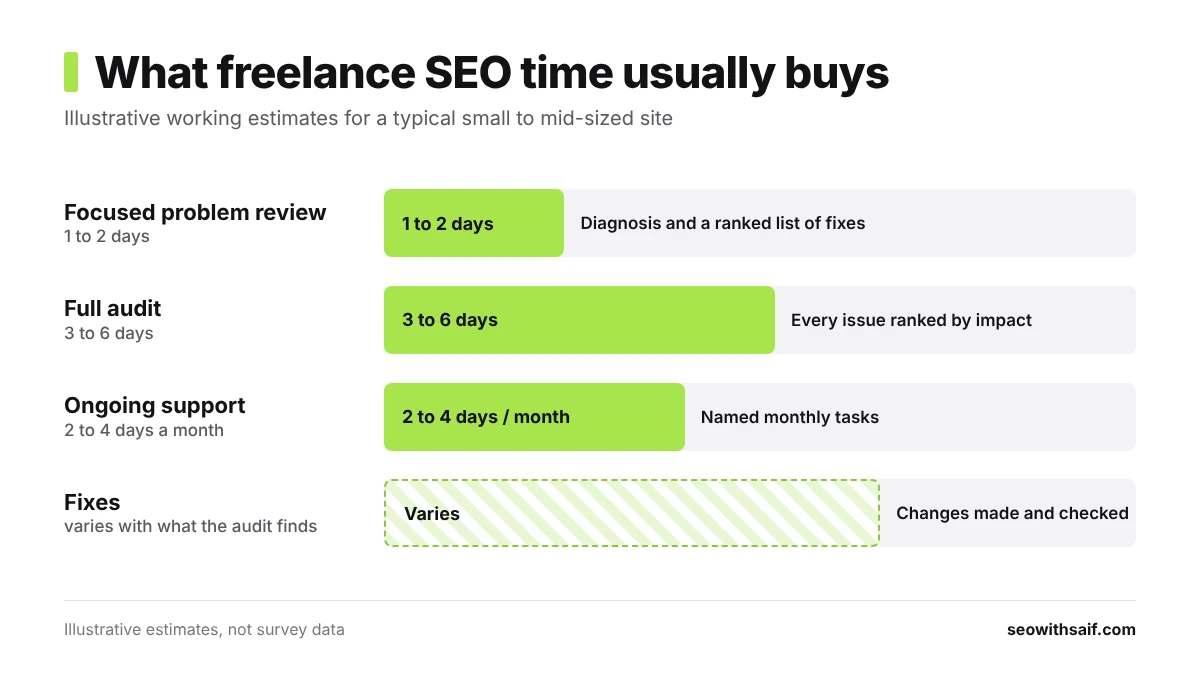
A day rate on its own tells you very little. What matters is how many days the work needs and what you get at the end of them. As a rough guide to how freelance time is typically spent:
| Type of work | Typical time | What you should get |
|---|---|---|
| Focused review of one problem (for example a traffic drop) | 1 to 2 days | A written diagnosis and a ranked list of fixes |
| Full technical and content audit | 3 to 6 days, depending on site size | Every issue found, ranked by impact, with how to fix each one |
| Fixing what the audit found | Varies widely | Changes made or specified, then checked |
| Ongoing monthly support | 2 to 4 days a month | Named tasks each month and a report you can follow |
These are my working estimates, not a market survey. Large ecommerce sites take longer to audit than a 20-page service site, and a site that has had years of patchy SEO usually needs more fixing than one starting clean.
My own work is billed at $25 to $49 an hour, with most projects starting from $1,000. I price by the problem rather than by the month where I can, because a clear problem with a clear fix should not turn into an open-ended retainer. There is a full breakdown of SEO pricing models in a separate guide if you want to compare retainers, projects and hourly work side by side.
How to check a freelancer before you hire
Google publishes its own advice on this, in a page called Do you need an SEO?. It suggests interviewing any SEO you are considering, asking for examples of previous work, and checking that they follow Google’s guidelines. It also points out that a good SEO will ask you about your business before proposing anything.
I would add five questions of my own. The answers tell you more than any portfolio.
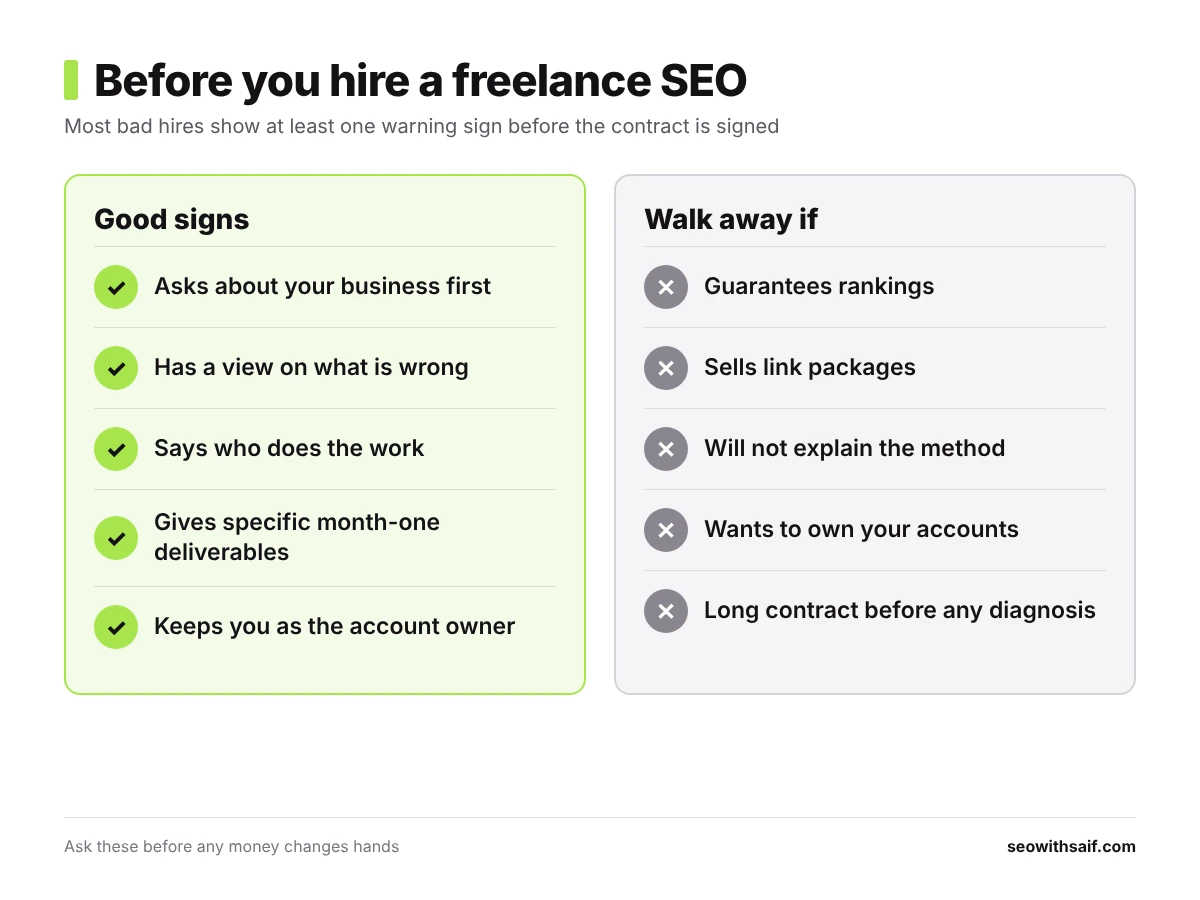
- “What do you think is wrong with my site?” A specialist who has looked at your site for twenty minutes should already have a hypothesis. Someone who answers with a package has not looked.
- “Who will actually do the work?” Some freelancers pass the work on to cheaper subcontractors and keep the margin. That can be fine if they say so. It is not fine if you only find out later.
- “Can you show me a result and explain what caused it?” Screenshots of rising graphs are easy to find. An explanation of what was changed and why it worked is harder to fake.
- “What would you not do for a business like mine?” Good freelancers turn work down. If nothing is ever outside their scope, be careful.
- “What will I get at the end of month one?” The answer should be specific: an audit document, a list of fixes made, a set of rewritten pages. “Optimisation” is not a deliverable.
If you are hiring in the capital, I have also written about how to judge SEO experts in London specifically, where the field is crowded and the agency pitches are polished.
Red flags that should end the conversation
Most bad SEO hires show warning signs before any money changes hands.
- Guaranteed rankings. Nobody controls Google’s results, and Google’s own hiring guide says as much. A freelancer who promises page one by a date is either guessing or planning shortcuts.
- Link packages. “50 high-authority backlinks a month” usually means paid links from sites built to sell them. That carries real risk of losing the rankings you have.
- Secret methods. A good specialist will tell you exactly what they plan to change. If the approach cannot be explained, you cannot judge it.
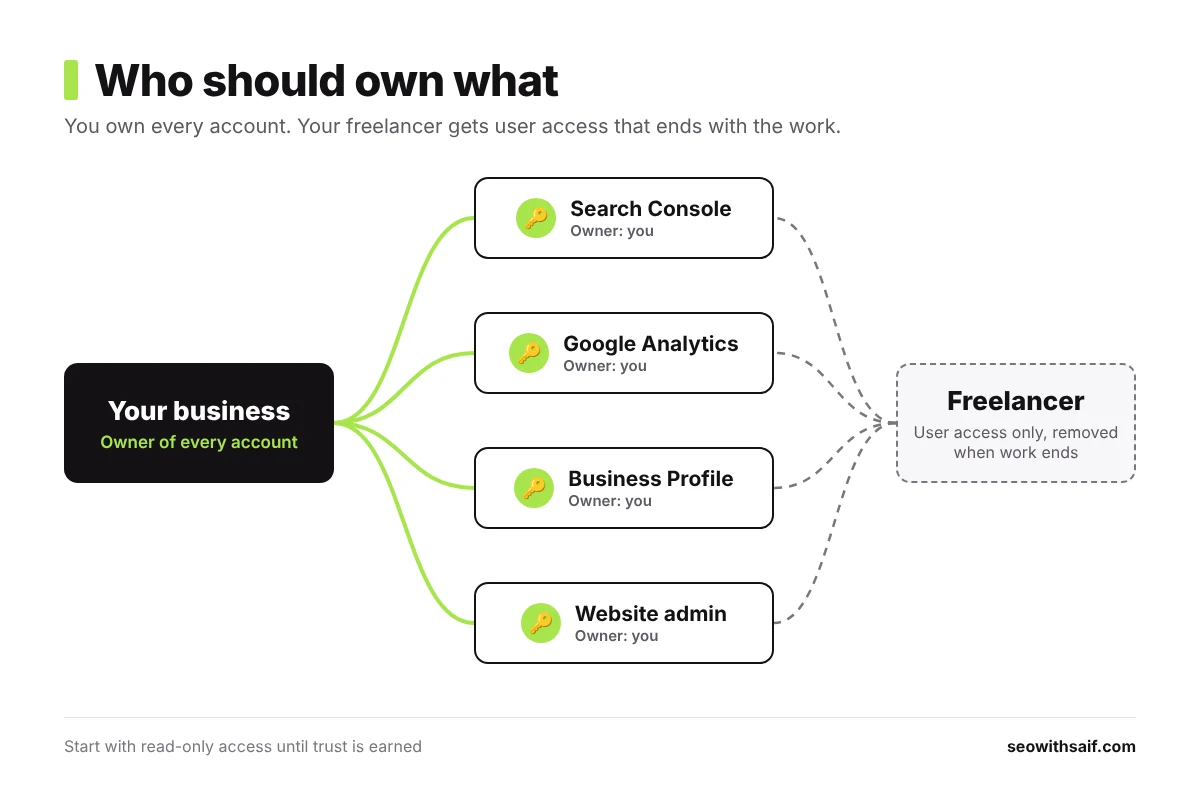
- Asking to own your accounts. Your Search Console, Analytics and Business Profile should belong to you. A freelancer should be added as a user, never become the owner.
- No questions about your business. If they do not ask who your customers are, what you sell and where enquiries come from, they are selling a standard plan. Here is how to spot a template package dressed up as custom work.
- Long contracts before any diagnosis. A twelve-month commitment signed before anyone has looked at your site protects the seller, not you.
What to agree in writing before work starts
A short written agreement saves most of the arguments that end freelance relationships. It does not need to be long, but it should cover:
- The problem being solved. One or two sentences, for example “find out why organic enquiries fell after March and fix the causes”.
- Deliverables and dates. What you will receive, and by when.
- Access and ownership. You own every account. The freelancer is added as a user and removed when the work ends. Start with read-only access until you trust them.
- Who makes changes to the site. The freelancer, your developer, or you. If it is your developer, the freelancer’s job is to specify changes clearly enough to be built correctly.
- How progress is reported. Which numbers, how often, and compared with what.
- Notice period. A month is common for ongoing work. Fixed projects end when the deliverables are handed over.
Ownership is the point people most often regret skipping. When a relationship ends badly and the freelancer owns the Analytics property or the Business Profile, getting it back can take weeks.
IR35: the UK rule most SEO hiring guides skip
If you are hiring a UK freelancer who works through their own limited company, the off-payroll working rules, usually called IR35, may apply.
Since 6 April 2021, medium and large private sector organisations have been responsible for deciding whether a contractor working through their own company should be taxed like an employee. If your business counts as small, that decision stays with the contractor’s company.
For most small businesses hiring a freelancer for a defined SEO project, this will not change much. For larger organisations, especially ones bringing a freelancer in for months to work alongside staff, it matters. I am not a tax adviser, so if you are a medium or large business, check the status of any long engagement with your accountant before it starts.
Does your freelancer need to be based in the UK?
Less than you might think, and more than some overseas freelancers admit.
What genuinely matters for a UK business is knowledge of the UK market: how British customers search, UK spelling on your pages, prices in pounds, and how local results work in UK towns. Someone who treats a UK site like a US one will get the details wrong, and the details are often what decides rankings.
What matters less is the freelancer’s postcode. Almost all SEO work happens in shared documents, screen shares and the accounts you give them access to. Time zone overlap for calls is worth checking, as is how quickly they reply.
I work remotely and I say so. I work with UK businesses alongside clients elsewhere, and the sites I work on are judged by what changes in Search Console, not by where I sit.
How I work with UK businesses
I am an independent technical SEO consultant, so the person you speak to is the person who does the work. Most projects follow the same order:
- Diagnosis first. I look at your site and your Search Console data before proposing anything, using what a proper technical audit should cover as the starting point.
- A ranked list of fixes. Each issue comes with its likely impact and how to fix it, so you can see why the order matters.
- Fixes made or specified. I either make the changes or write them clearly enough for your developer to build correctly.
- Measure, then decide. We check what moved before agreeing any further work.
If your traffic fell suddenly rather than never growing, the job is different, and recovering from a traffic drop starts with what changed and when, often lined up against this year’s Google updates. If your site is large and full of old content, the first step may be working out which pages are worth keeping. And if you are not sure what is wrong at all, these common reasons SEO stalls are a good place to start.
Frequently asked questions about hiring a freelance SEO expert in the UK
How much does a freelance SEO expert cost in the UK?
YunoJuno’s booking data puts the average SEO consultant day rate at £374, with specialists charging more. Many freelancers also price fixed projects, such as an audit, or monthly support by the day. My own work is $25 to $49 an hour, with most projects starting from $1,000.
Is a freelance SEO expert better than an agency?
Neither is better in general. A freelancer is usually the better fit for diagnosing and fixing specific problems, because the person you speak to does the work. An agency suits businesses that need large volumes of content, links and reporting every month.
How long before I see results from a freelance SEO expert?
Technical fixes on an established site can show within weeks. New pages and authority building usually take a few months. Be wary of anyone who promises first-page rankings by a fixed date.
Should I pay a monthly retainer or per project?
Start with a project. A defined audit or fix tells you how the freelancer works and whether their diagnosis holds up. Move to monthly support only once there is a clear list of ongoing work to do.
Do I need to worry about IR35 when hiring a freelance SEO consultant?
Only if the freelancer works through their own limited company and your business is medium or large. In that case you are responsible for deciding their employment status for tax. Small businesses are not. Check longer engagements with your accountant.
Can a freelance SEO expert guarantee page one on Google?
No. Nobody controls Google’s results, and Google’s own hiring advice warns against anyone who claims to. A good freelancer will tell you what they expect to improve, how they will measure it and what could limit it.
What clients say
“Very much enjoyed working with Muhammad. A-star SEO expert! Have and would reccommend.”
Kim Walls, Malin (USA)
“Working with Muhammad and his team has been a key driver in obtaining new leads for our B2B SaaS product.”
Brandon Parham, Cleri (USA)
Find out what is holding your site back
If you are about to hire a freelance SEO expert, start with a diagnosis rather than a package.
In a free 1:1 strategy call, I will look at your site and your search data, tell you what I think is holding it back, and what I would fix first. You get clear next steps, with no ranking guarantees and no pressure to buy work you do not need.