
You have published 140 blog posts over three years and traffic has been flat for the last eighteen months. Nothing is broken, nothing got penalised, and yet adding more posts stopped moving the number a while ago. That is the exact point where people start asking what a content audit is, usually because someone told them they needed one without explaining why.
Short version: it is a page by page review of everything you have published, ending in a decision about each one. Not a report. A decision.
Let me explain what that actually involves and when it is worth your time.
What a content audit is, and what it is not
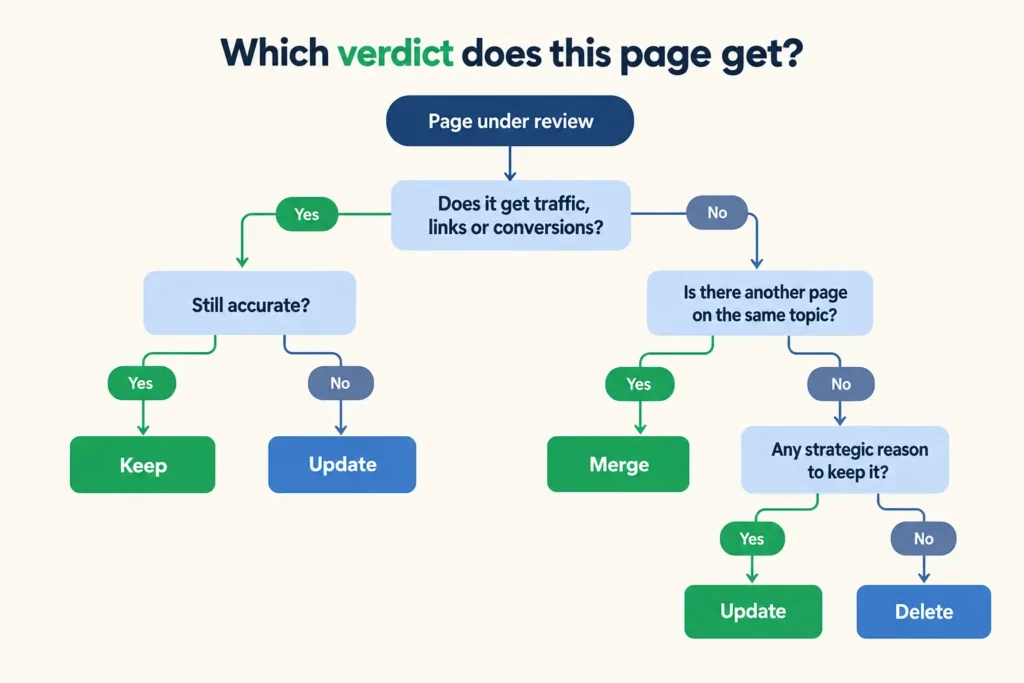
A content audit means listing every URL you have, pulling performance and quality data against each one, and assigning a verdict: keep it as is, rewrite it, merge it into another page, or remove it.
The Nielsen Norman Group draws a useful line here between an inventory and an audit. The inventory is the list. The audit is the judgement you apply to that list. Most of what gets sold as a content audit stops at the inventory, which is why so many people receive a 400 row spreadsheet and have no idea what to do next.
Two things it is not.
- It is not a technical audit. Crawl errors, site speed, indexation and canonicals belong in a technical SEO audit. Different problem, different process. If Google cannot crawl your site properly, fix that first, because auditing content on a site that cannot be crawled cleanly wastes everybody’s time.
- It is not a rewrite exercise. Plenty of pages come out of an audit with a verdict of leave alone. That is a real result, not a failure to find work.
Why most of the pages on your site get no traffic
This is the part that surprises owners, so it is worth sitting with.
Ahrefs studied roughly 14 billion pages and found that 96.55 percent of them get no organic traffic from Google at all, with a further 1.94 percent getting between one and ten visits a month. That is not a statement about bad writing. It is a statement about how concentrated search traffic is.
In the audits I run, the dead pages usually fall into three groups, and the fix is different for each.
Pages competing with each other. Three posts on nearly the same topic, published a year apart because nobody checked. Google picks one, often the weakest, and splits the signals across all three.
Pages targeting a query nobody types. Written from an internal idea rather than from a search someone actually makes.
Pages that are fine but invisible. Nothing links to them internally. If a page sits four clicks from your homepage with no internal links pointing at it, it will struggle no matter how good the writing is.
“Muhammad is an excellent SEO Expert. He totally understands SEO inside out and delivers results that actually make a difference. Communication was easy, and he always kept me updated on progress.” – Melissa Gerhold, client feedback
The four verdicts, and what each one means
Every page gets exactly one of these. No maybes, no third tier.
| Verdict | When I use it | Typical effort | What it fixes |
|---|---|---|---|
| Keep | Page earns traffic or conversions and is still accurate | None | Nothing, and that is fine |
| Update | Right topic, weak execution, or facts have gone stale | 2 to 5 hours | Relevance, freshness, depth |
| Merge | Two or more pages chasing the same query | 3 to 6 hours plus a redirect | Cannibalisation, split authority |
| Delete | No traffic, no links, no conversions, no strategic reason | Minutes plus a redirect decision | Crawl waste, quality dilution |
The merge verdict is the one that produces the biggest gains and the one people skip most often, because combining two posts into one feels like losing something. It is not. You are consolidating the links, the rankings and the topical depth of both into a single stronger page.
How I actually run one
The process is not complicated. Doing it consistently across 200 pages is the hard part.
- Crawl the site to get every indexable URL, not just the ones in your CMS menu. Screaming Frog or Sitebulb both do this.
- Pull 12 months of Search Console data per URL: clicks, impressions, average position, and the queries each page actually receives.
- Add engagement and conversion data from analytics. A page with low traffic that converts at 8 percent is not a dead page.
- Read the pages. This is the step everyone skips and it is the only step that catches thin content, wrong intent, and facts that expired two years ago.
- Assign one verdict per row, then sort by expected impact rather than by traffic.
For a site under 100 pages this is a couple of days of work. Above 500 pages it becomes a sampling exercise, because reading every page individually stops being realistic and you start auditing by template and by section instead. If you run a local business in Milford, CT, here is how I apply this process when doing search engine optimization in Milford.
The mistake that costs people most: deleting too fast
Somebody reads that pruning improves quality signals, exports every zero traffic URL, and bulk deletes 300 pages in an afternoon. I have been called in to undo this more than once.
Three checks before anything gets removed:
- Does it have backlinks? A page with referring domains is an asset even at zero traffic. Redirect it, do not delete it.
- Does it convert? Comparison pages and pricing pages often get very little search traffic and still close deals. That is a conversion question, not a traffic one.
- Is it seasonal or new? A post published eight weeks ago has not had a fair run yet.
When a page genuinely goes, 301 redirect it to the closest relevant page rather than letting it 404. Blanket redirecting everything to the homepage is treated as a soft 404 and gains you nothing.
What to expect afterwards
I am not going to promise you a traffic jump, and you should be sceptical of anyone who quotes a percentage before seeing your site.
What I can tell you from doing this repeatedly:
- Merges tend to move first, often within four to eight weeks, because you are consolidating authority that already exists rather than building new authority.
- Updates take longer, usually two to three months, and depend heavily on how competitive the query is.
- Deletions rarely produce a visible gain on their own. They reduce crawl waste and tidy up quality signals, which helps everything else work better. Treat it as maintenance rather than growth.
If your traffic has been falling rather than merely flat, a content audit may not be the right starting point at all. Falling traffic usually has a specific cause, and it is worth reading why SEO stops working before spending weeks on content.
FAQ
What is included in a website content audit?
A full inventory of every indexable URL, 12 months of Search Console performance per page, engagement and conversion data, a manual quality read, and a single verdict for each page. You should also get a priority order, so you know what to action first. If what you receive is a spreadsheet with no verdicts and no sequence, you received an inventory, not an audit.
What is the purpose of a content audit?
To stop guessing which pages deserve investment. Most sites carry a large number of pages that earn nothing and quietly dilute the site, while a handful of pages do all the work. The audit tells you which is which, and gives you a defensible reason to update, merge or remove each one instead of defaulting to publishing more.
What is a GEO audit for a website and its content?
A GEO audit checks whether AI systems can find, understand and cite your content, rather than whether Google ranks it. It looks at entity clarity, structured data, question and answer formatting, and whether you are mentioned in the sources those systems already trust. It overlaps with a content audit but asks a different question. I cover the approach in more detail in my guide to generative engine optimization.
Can you give some examples of content audits?
Three common shapes. A blog audit on an established site, where the usual outcome is merging clusters of overlapping posts. An ecommerce audit, where thin category pages and near duplicate product descriptions dominate the findings. A service site audit, where the problem is typically a handful of pages carrying every commercial keyword while dozens of blog posts target nothing at all.
What tools do I need for a content audit?
A crawler such as Screaming Frog or Sitebulb, Google Search Console for query and click data, and your analytics platform for conversions. Ahrefs or Semrush help with backlink and ranking context but are optional for a small site. The spreadsheet where you assign verdicts matters more than any tool in that list.
Get a second opinion before you delete anything
If you are sitting on a few hundred pages and you are not sure which ones are helping, the cheapest useful step is finding out before you start rewriting.
Send me your domain and I will run the crawl and the Search Console pull myself. Within three business days you will get a short written summary: how many pages earn nothing, which clusters are competing with each other, and the five changes I would make first. No deck, no call required, and you are free to hand the list to your own writer.