Last month your business showed up in the Google map pack. This month it is gone, or it sits three pages deep while a newer competitor holds the spot you used to own. That kind of drop feels personal, and it usually arrives with no warning and no email from Google. In most of the cases we look at, the cause is not a mysterious algorithm penalty. It is something inside the Google Business Profile itself, often a setting that was changed, missed, or never set correctly in the first place. The good news is that most of these problems are fixable, and the profile usually recovers once the signal is corrected.
What slipping local rankings usually means
Google ranks local results on three things it states plainly: relevance, distance, and prominence. You can read Google’s own guidance on local ranking for the short version. Distance you cannot move. Relevance and prominence you can, and that is where almost every ranking problem we audit actually lives.
Relevance is how clearly your profile and website tell Google what you do. Prominence is how trusted and active your business looks across the web. When a profile slips, one of those two has weakened, usually because a detail changed or an old shortcut finally caught up with the listing. Before assuming a penalty, we check the boring fundamentals first. They are almost always the answer.
The wrong primary category quietly caps your reach
Your primary category is the single strongest signal you control. Google uses it to decide which searches you are even eligible to appear for. Choose a category that is close but not exact, and you cap your own visibility before anything else gets a chance to help.
We see this constantly. A business that does kitchen remodeling lists itself as “Contractor.” A personal injury firm lists “Law Firm.” Both are technically true, and both are too broad, so the listing competes in a wider, vaguer pool and loses to a competitor who picked the specific category that matches the search.
Fix the primary category first. Be as specific as the list allows, then add secondary categories for the other services you genuinely offer. Do not add categories you do not actually serve, because that dilutes relevance instead of building it.
Saif is a true professional in this area. He turned our slow business into a running machine, and now we don’t rely on Google Ads all the time. ” Jesse Kochen “
Keyword stuffing your business name invites a suspension
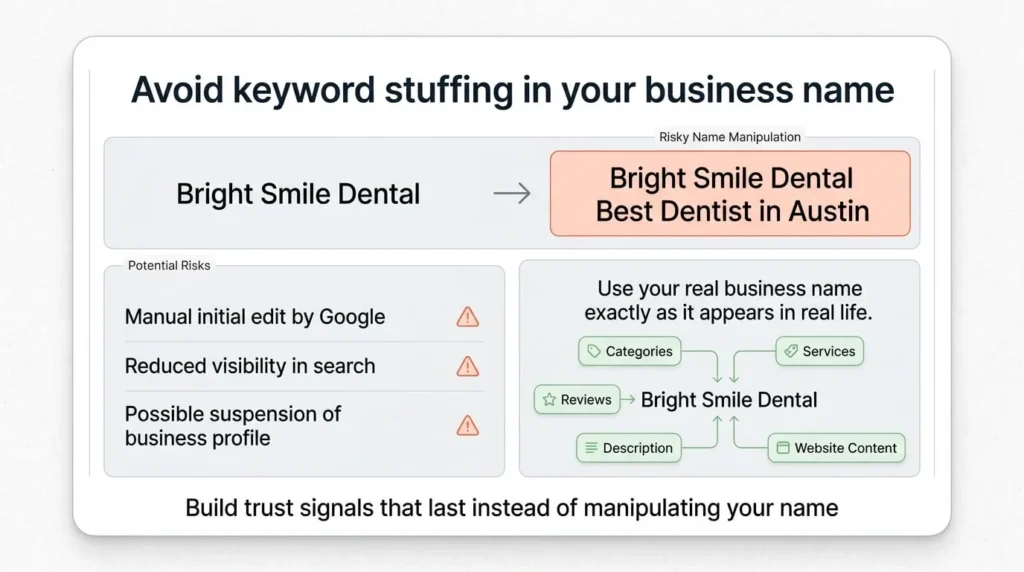
It is tempting to change your name from “Bright Smile Dental” to “Bright Smile Dental | Best Dentist in Austin.” It can even work for a little while. Then it stops working.
Adding keywords or city names to your business name breaks Google’s guidelines. The listing may get a manual edit, lose visibility, or get suspended outright, and a suspended profile is invisible while you wait out an appeal. We have cleaned up listings where a short-term name trick turned into weeks offline.
Use your real-world business name, the one on your signage and your invoices. Build relevance through categories, services, your description, reviews, and the content on your website. Those signals last. A stuffed name is a liability sitting in plain sight.
Inconsistent NAP and a website that does not back up your profile
Two quieter problems travel together more often than owners expect.
The first is inconsistent name, address, and phone details across the web. One wrong digit, an old suite number, a former business name still sitting on a directory, and Google grows less certain your business is what and where you say it is. That uncertainty costs you trust, and trust feeds prominence.
The second is a website that does not support what the profile claims. If your profile says you offer water heater installation but your site barely mentions it, Google receives a mixed message. In most of the audits we run, the profile looks fine on its own, and the real weakness is the thin website sitting behind it. Your site is the relevance engine for your local rankings. A few short brochure paragraphs do not give Google enough reason to trust you over a competitor who explains the service in depth.
Match your details everywhere. Then make sure each service you want to rank for has a real page that actually covers it.
Treating your profile as a one-time setup
A profile that was filled out once and never touched again starts to look abandoned, to customers and to Google. Photos go stale. Hours drift out of date. Reviews pile up with no reply.
Reviews deserve special attention, because recency now carries real weight. A business with a steady trickle of recent reviews tends to outperform one with a larger pile of old ones. Velocity and freshness matter, not just the total. So a listing that earned forty reviews two years ago and nothing since is quietly losing ground to a competitor gathering two a month.
You do not need to post every day. You do need signs of life: occasional photos, current hours, and replies to reviews, including the awkward ones. Activity tells Google the business is real and running.
Provided best support to optimise my gmb for Resort ” Hill Crowns “
The Q&A change that caught most owners off guard
Here is a recent shift many owners missed. Google retired the public Q&A section on Business Profiles, starting the phase-out in late 2025 and replacing it with AI-generated answers inside Search and Maps. A customer now asks a question, and Gemini answers it using your profile, your reviews, your photos, and your website.
That matters because you no longer control those answers by typing them into a Q&A box. Google pulls them from whatever data it can find, and if the data is missing or contradictory, the AI either guesses or stays silent. Neither outcome helps you.
The fix is to move that information where Google can read it cleanly. Put the questions customers actually ask, with clear answers, into your business description, your services, and the relevant pages on your website. If a customer used to ask it in Q&A, your site and profile now need to answer it directly.
How long recovery takes, and what we can honestly tell you
This is where we stay honest with you. Local rankings do not snap back the moment you fix a setting. After a correction, most profiles we work on begin moving within a few weeks, and competitive categories or crowded cities can take longer. A suspension appeal adds its own unpredictable wait on top.
No one can guarantee a specific position, and anyone who promises you the top spot by a fixed date is guessing. What we can tell you is which mistakes are dragging you down, what fixing each one should reasonably do, and how to build signals that hold instead of shortcuts that invite the next suspension. If you want a second set of eyes, a local SEO consultant can usually tell you within a single audit which of these is actually your problem
Frequently Asked Questions
Why is my Google Business Profile not ranking even though it is verified and complete?
Verification and completeness are the floor, not the finish line. If you are still not ranking, the usual culprits are a primary category that is too broad, inconsistent details across the web, a thin website behind the profile, or strong competitors with more reviews and activity. Check your category and your review recency before assuming something is broken.
How long does it take to recover local rankings after fixing mistakes?
Expect a few weeks in most cases, sometimes longer in competitive cities or crowded categories. Google needs time to recrawl and re-trust the corrected signals. If the listing was suspended, add the appeal review window on top. Anyone quoting you an exact day for the top spot is guessing rather than telling you how local search actually moves.
Can keywords in my business name really get my profile suspended?
Yes. Adding keywords or city names that are not part of your real, registered business name breaks Google’s guidelines and is a common suspension trigger. It might lift you briefly, then cost you the listing for weeks. Use your true business name and earn relevance through categories, services, reviews, and your website instead.
What happened to the Q&A section on my profile?
Google began removing the public Q&A feature in late 2025 and now answers customer questions with AI inside Search and Maps. You can no longer pre-write those answers in a Q&A box. Put the details customers ask about into your business description, services, and website, so Google has accurate information to pull from.
Find what is actually holding your profile back
If your rankings slipped and you are not sure why, the fastest path is to stop guessing and get the profile audited. A focused review usually takes a day or two and walks through every item above: category, business name, NAP consistency, the website behind the listing, reviews, and the recent Google changes. You walk away knowing what is wrong, what to fix first, and what to reasonably expect afterward.