Your calls are down, but your rankings haven’t moved. That is the exact pattern we hear from local owners right now, and it usually points to one thing: your customers are getting their answer from AI before they ever reach your listing.
Someone asks ChatGPT “who does emergency AC repair near me open now” or types a question into Google and reads the AI Overview at the top. If your business is not named in that answer, you never had a chance to compete, even if you rank number one in the map pack. That is the problem answer engine optimization for local business solves, and below is what it actually involves.
What answer engine optimization for local business actually means
Answer engine optimization (AEO) is the work of getting your business named and cited inside AI-generated answers, the ones from Google AI Overviews, AI Mode, ChatGPT, Gemini, and Perplexity. Traditional SEO tries to rank your page in a list of links. AEO tries to make your business the answer itself.
For a local business the stakes are specific. When someone asks an AI assistant for the best plumber in your city, the model assembles a shortlist from sources it trusts. You are either on that shortlist or you are invisible. There is no page two to scroll to.
Here is the part most owners miss. These systems do not just read your website. They pull from your Google Business Profile, Yelp, Apple Maps, Bing Places, and any directory that mentions you. If that data is thin or inconsistent, the AI has no confident reason to name you.
Why your rankings can hold while your calls drop
This is the disconnect that worries people, and it is worth explaining plainly. You can keep your position in the local pack and still lose the customer, because the customer resolves their question inside the AI answer and never taps through.
Around 60% of Google searches now end without a click to any website. On mobile, where most local searches happen, the call button is being pushed further down by AI answers and expanded panels. So the ranking report looks fine while the phone stays quiet.
In most of the sites we audit, the cause is not a ranking drop at all. It is that the business is well reviewed and qualified but structurally invisible to AI, because nothing on the site or in its listings is formatted as a clear, extractable answer to the questions people are asking.
Saif fixed indexing and structure issues on our site that three other people missed. Traffic and calls both recovered within a few weeks.
What AI actually looks for before it names you
AI systems favor sources that are clear, consistent, and demonstrably trustworthy. For a local business, three things carry most of the weight.
- Consistent business data everywhere. Your name, address, phone, and hours must match across your site, Google Business Profile, and every directory. A slight variation in your address format across platforms is one of the most common reasons a business gets excluded from AI results.
- Content structured as direct answers. Pages that open with a plain, 30 to 60 word answer to a real question get extracted far more often than pages that bury the answer three paragraphs down.
- Reputation and mentions the model can verify. Reviews, and mentions of your business across trusted third-party sites, tell the AI you are real and credible. AI weighs the words inside reviews, not just the star rating, to see whether customers name the service you want to be known for.
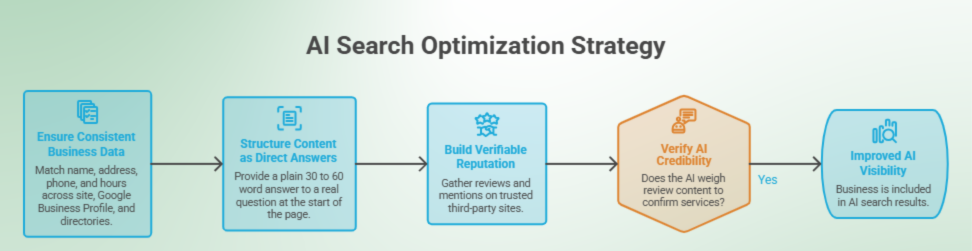
The reasoning behind this is simple. These platforms exist to give one confident answer. They will only stake that answer on a business they can cross-reference and trust.
The first move that usually matters most
If you do one thing this month, make your business data identical everywhere and clean up your Google Business Profile. It is the least glamorous fix and the one that moves the needle fastest, because your profile is often the primary source AI pulls from for local answers.
Get your categories specific and correct. Fill in every field. Make sure your hours, services, and phone number match your website exactly. Many local owners are quietly bleeding visibility through small profile errors, which is why we flag Google Business Profile mistakes that kill rankings as the first place to look.
After that, pick your ten most common customer questions and answer each one clearly at the top of a relevant page. Short answer first, detail below. That single structural habit is what makes your content easy for an answer engine to lift and cite.
We had gone through two agencies before this. The difference here was that the work was explained and the results actually showed up in our leads.
What you can realistically expect
Be clear-eyed about the timeline. If your site already has a solid SEO foundation, you can see early movement in four to six weeks, usually on lower-competition questions. Consistent, measurable citation patterns tend to take three to six months of steady work.
No one can guarantee placement in an AI answer, and anyone who does is selling you something. What you can control is whether your business is structured, consistent, and credible enough to be a candidate. Google itself confirms that businesses with complete, accurate information are more likely to surface in local results, and the same logic drives AI answers.
There is one honest caveat. If your underlying reputation is weak, AEO will not paper over it. These systems surface sentiment, so the fix sometimes has to start with the actual service, not the markup.
Frequently asked questions
What is the difference between AEO and SEO for a local business?
SEO works to rank your website in the list of search results so people click through to you. AEO works to get your business named inside the AI-generated answer people read first, whether that is an AI Overview, a voice result, or a ChatGPT response. They overlap heavily and share the same foundations, but SEO gets you found while AEO gets you chosen.
How long does local AEO take to show results?
For a business with an existing SEO foundation, early wins often appear within four to six weeks on less competitive questions. Reliable, repeated citations across AI platforms usually take three to six months of sustained work. New sites with little authority take longer, because trust has to be built before an answer engine will confidently name you.
Do I need to replace my current SEO with AEO?
No. AEO builds on SEO rather than replacing it. Answer engines frequently pull from content that already ranks well organically, so a strong SEO base makes your AEO efforts work faster. The right approach is to keep your SEO healthy and layer answer-focused structure and clean listings on top of it.
Can I do local AEO myself?
You can handle the foundational moves yourself: fixing NAP consistency, cleaning up your Google Business Profile, and rewriting key pages to answer real questions directly. The harder parts, like schema implementation, entity signals, and diagnosing why AI is skipping a well-reviewed business, are where most owners get stuck and where an experienced hand saves months.
Does AEO help if my Google reviews are weak?
Only up to a point. AI systems read the sentiment and wording inside reviews, not just the star count, so a thin or negative review profile will limit how often you get recommended. AEO can make a genuinely good business visible, but it cannot disguise a reputation problem. In that case, the reviews come first.
Ready to find out why AI is skipping your business?
If your rankings look fine but your calls are sliding, the fastest way forward is a straight answer about what is actually happening. We will audit how your business currently appears across Google’s AI results, your Business Profile, and the directories AI pulls from, then show you the specific gaps and the order to fix them.
You will walk away with a clear picture in about a week, whether or not you work with us further. Reach out through our local SEO recovery specialist page to get started.