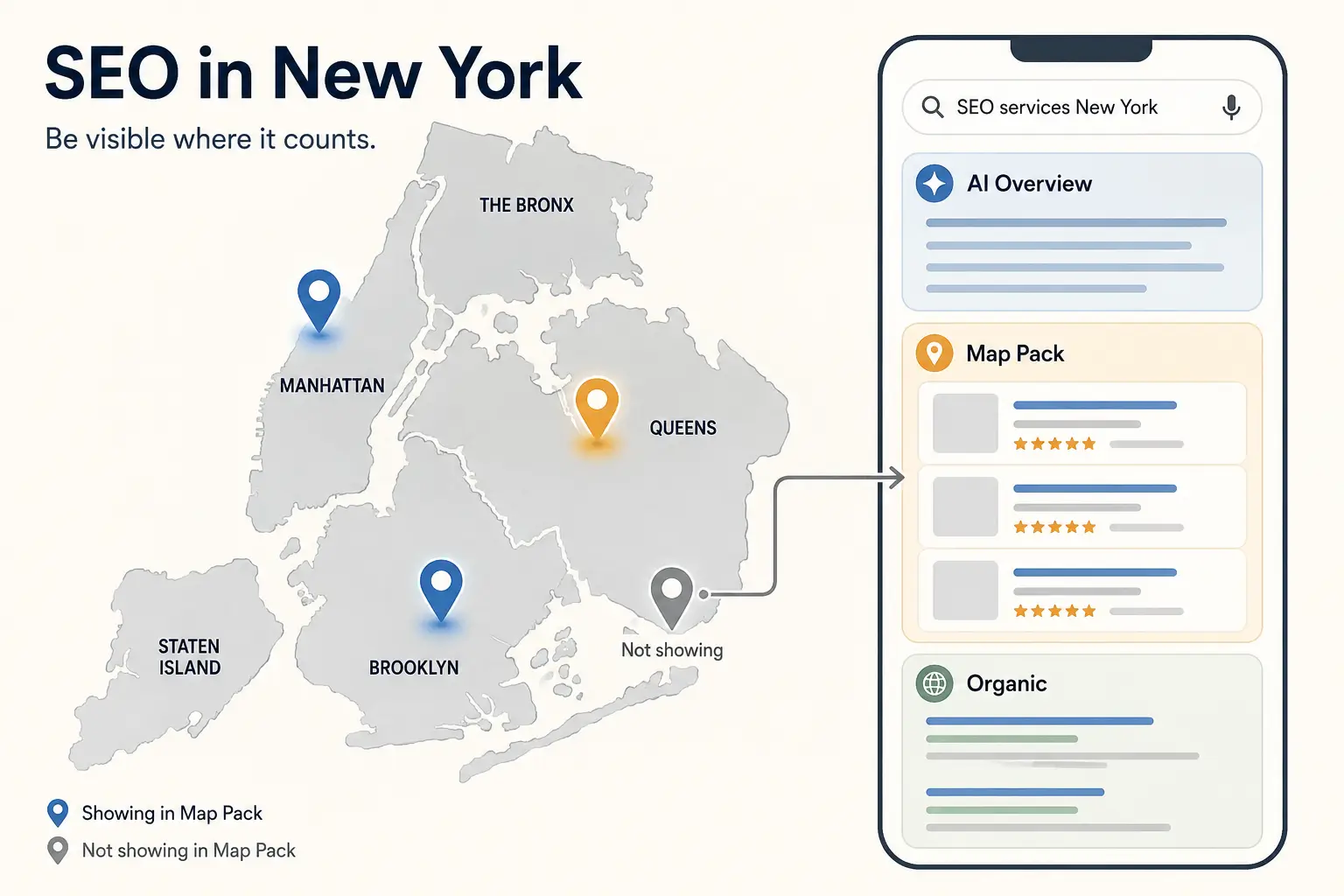
Your phone used to ring three or four times a day. Now it rings once, maybe, and the website looks identical to how it looked six months ago. That is the message I get most weeks from owners in Brooklyn, Midtown and Long Island City, and SEO in New York is almost always where the problem is hiding. Nothing broke visually. Something changed in how Google decides who gets shown to a person standing four blocks from your door.
Let me tell you what that usually means, because it is rarely what owners assume.
What a drop in New York search visibility usually means
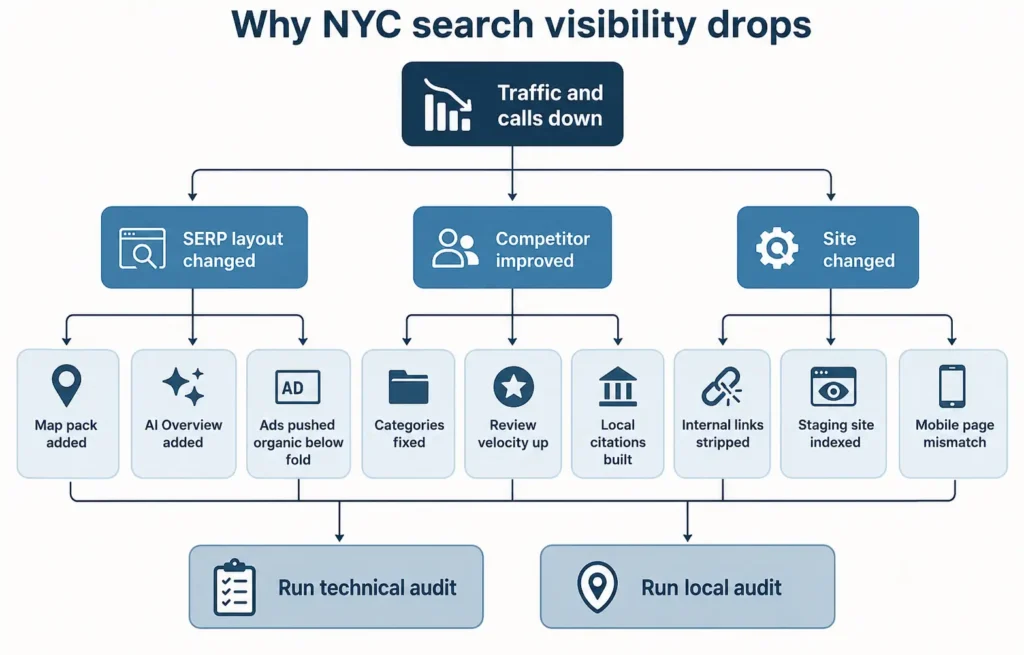
Owners come to me convinced they have been penalized. In the audits I run, an actual manual action is rare. Far more often, one of three quieter things happened.
The query you built your site around stopped returning ten blue links. Google replaced the top of that result page with a map pack, an AI Overview, or both, and your organic position four is now sitting below the fold on a phone. You did not lose the ranking. You lost the real estate around it.
Or a competitor two neighborhoods over finally did the boring work. They fixed their categories, earned twelve local citations, and started collecting reviews weekly instead of never.
Or your own site quietly changed. A theme update stripped your internal links. A developer added a staging subdomain that Google indexed. A plugin started serving a different page to mobile.
None of that shows up in your dashboard as a red warning. It shows up as a slow bleed in calls.
Why New York is harder than almost any other market
There are more than 183,000 small businesses operating across the five boroughs, the highest number in the city’s recorded history, according to the NYC Department of Small Business Services. That number matters more than it looks.
It means the density of competitors for any given service term in New York is unlike Ohio or Kent. Twenty plumbers can serve the same six blocks. Google cannot show twenty. So it leans harder on proximity, on entity signals, and on which business it has the most consistent data about.
Two consequences follow, and both catch owners off guard.
- Proximity outweighs quality more than you would like. A weaker competitor with an office closer to the searcher can and will outrank you in the map pack for a job you are better equipped to do.
- One citywide page will not cover you. A single “Areas We Serve: NYC” page does almost nothing. Google is resolving searches at the neighborhood level, not the metro level.
This is also why generic SEO services in New York often underdeliver, and why local search work has to be built neighborhood by neighborhood. A national agency runs a national playbook on a market that behaves like twenty separate markets stacked on top of each other.
“Working with Muhammad and his team has been a key driver in obtaining new leads for our B2B SaaS product. I am extremely happy with his SEO expertise and content writing, and would highly recommend him. For founders looking for a solid GTM strategy or continuing service, Muhammad is your guy!!!” – Brandon Parham- Cleri (USA)
The four causes I find most often on NYC service sites
I have audited enough local sites now to know where to look first. Roughly in order of frequency:
Duplicate location pages. Somebody spun up one page per borough, same 400 words, only the place name swapped. Google folds them together and picks one, usually the wrong one. If your Queens page and your Bronx page are 90 percent identical, they are competing with each other rather than with your competitors.
Google Business Profile categories that were never revisited. The primary category is the single heaviest lever in the map pack. I still find businesses whose primary category was picked in 2019 by whoever set up the listing, and it no longer matches what they sell.
Thin service pages behind a beautiful homepage. The homepage gets all the design attention. The page that should rank for the money term has two paragraphs and a contact form.
Crawl waste. Faceted URLs, tag archives, filter parameters. On larger sites this is a real problem, and it is worth working through a proper technical SEO audit before touching content at all.
The order matters. Fixing content on a site that Google cannot crawl cleanly is expensive and slow.
Where New York businesses actually lose: three different surfaces
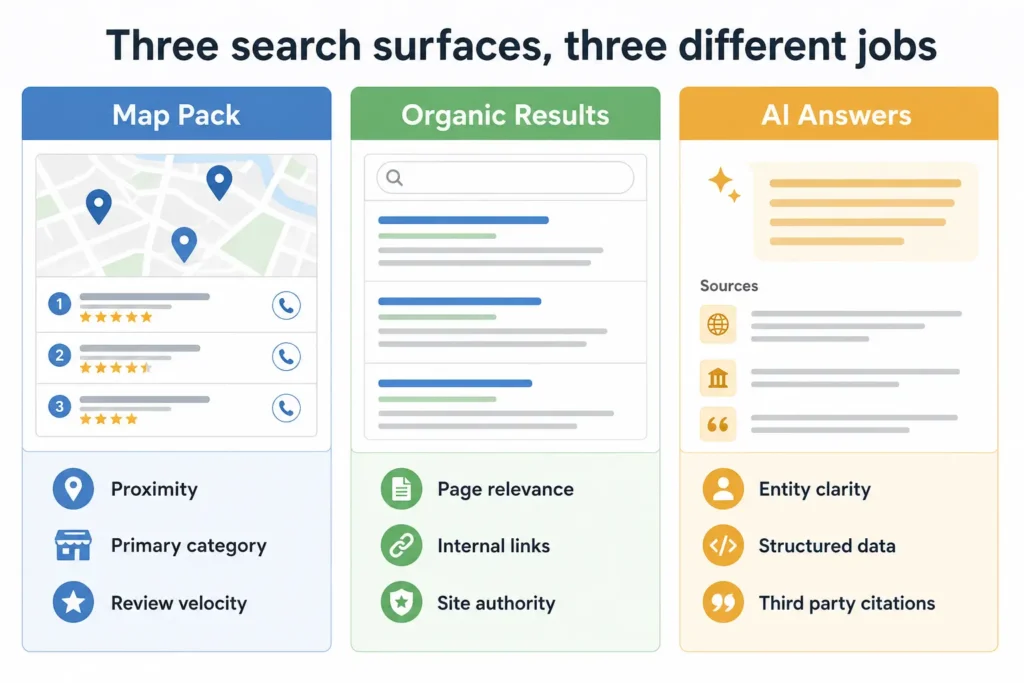
Search is no longer one result page. You can be visible on one surface and invisible on the other two, which is exactly why owners tell me their rankings “look fine” while their calls do not.
| Surface | What wins it | What it drives | Typical blind spot |
|---|---|---|---|
| Map pack | Proximity, primary category, review volume and velocity, NAP consistency | Calls, direction requests, walk-ins | Profile set up once and never touched |
| Organic listings | Page relevance, internal linking, site authority, page experience | Research traffic, form fills, quotes | Thin or duplicated service pages |
| AI answers and overviews | Clear entity data, structured content, being cited by trusted sources | Brand mentions, high intent referrals | No structured markup, no citable content |
Google’s own consumer research found that 76 percent of people who search on their smartphones for something nearby visit a business within a day. In a walking city, that window is even shorter. Losing the map pack is not a ranking inconvenience. It is same-day revenue going to whoever is showing instead of you.
If the third column is new to you, that is worth reading up on. Start with how local businesses get cited in AI answers.
What competitor analysis looks like when it is done properly
Most “competitor analysis” I see handed over is a keyword gap export with 400 rows and no decision attached to it. That is a report, not analysis.
Here is what I actually do for a New York client, in order:
- Identify who ranks for the five queries that genuinely produce revenue, not the vanity head term.
- Separate map pack competitors from organic competitors. They are frequently different companies, and confusing them wastes months.
- Check review count and, more importantly, review velocity. A competitor gaining four reviews a month is telling you something a static total cannot.
- Pull their top landing pages and look at what those pages answer that yours does not.
- Check their backlink profile for local sources you could plausibly earn: neighborhood associations, borough press, supplier directories, trade bodies.
The output should be a short list of things to change this quarter. If it does not end in decisions, it was not analysis.
Seowithsaif really gets it done! They helped rank my UGC business higher on google search. I also started showing up in ChapGPT results which was a huge bonus. Highly recommend this guys for websites and SEO! – ” Bo Green”
What you can realistically expect, and what you cannot
I am not going to promise you a position, and you should be wary of any SEO agency in New York that does. Nobody controls Google’s ranking systems, and anyone claiming otherwise is selling certainty they do not own.
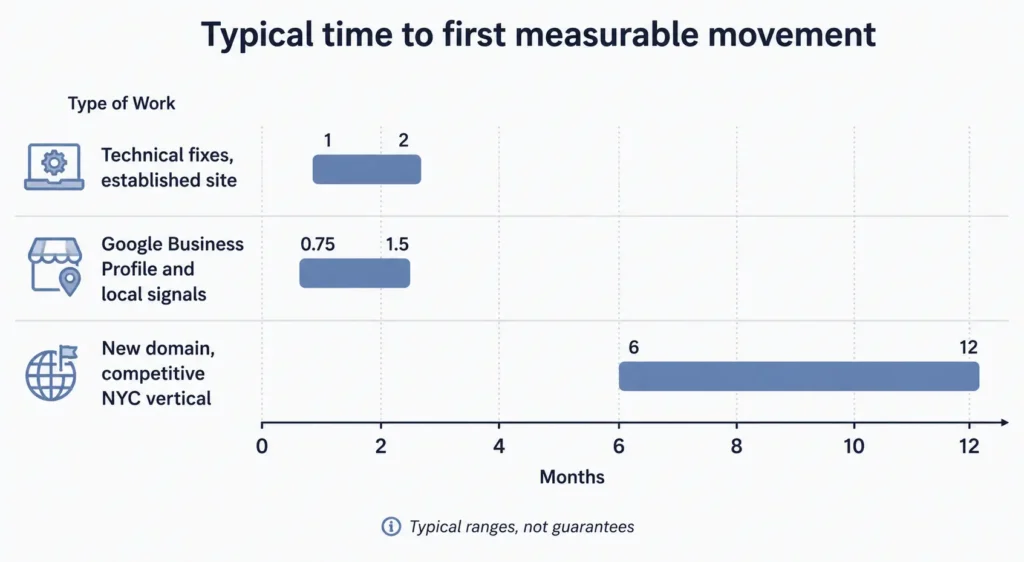
What I can tell you from repeated experience is roughly how the timing tends to run:
- Technical fixes on an established site: movement often visible in four to eight weeks, because the authority already exists and you are removing an obstacle.
- Google Business Profile and local signal work: first changes in map pack behaviour typically in three to six weeks.
- New domain in a competitive NYC vertical: realistically six to twelve months before it pays for itself.
Those are typical ranges, not guarantees, and your situation may sit outside them. A site with a history of aggressive link buying will take longer. A site in a niche with three real competitors will move faster. If someone quotes you a timeline before looking at your site, they are guessing.
If your traffic fell off a cliff rather than drifting down, that is a different problem with a different process, and it is worth reading why SEO stops working first, then looking at search visibility recovery.
FAQ
How do I rank in New York SEO?
Pick the borough or neighborhood you actually serve and win that first, rather than chasing a citywide term. Build one genuinely distinct page per service and per area, get your Google Business Profile categories right, and collect reviews on a steady schedule instead of in bursts. Then earn links from local sources. Citywide rankings in New York are usually the result of neighborhood strength, not the starting point.
What is competitor analysis in SEO for New York City?
It is working out which specific businesses are taking the searches you want, on which surface, and why. In NYC that means treating map pack competitors and organic competitors as two separate lists, since they rarely overlap. You compare review velocity, service page depth, and local link sources. The point is to produce a short list of changes for this quarter, not a spreadsheet nobody opens.
Which companies provide excellent SEO services in New York?
There is no single correct answer, and I would distrust any article that gives you one. Directories like Clutch and Semrush Agency Partners list vetted New York firms with verified client reviews, which is a reasonable starting point. When you shortlist, ask for two case studies in your vertical, ask who does the work day to day, and ask what happens if results stall. Vagueness on that last question tells you plenty.
How much does SEO in New York cost?
Retainers in this market commonly run from a few hundred dollars a month for narrow local work up to several thousand for competitive multi-location campaigns. Price tracks scope and competition, not agency size. Be careful at the very bottom of the range, where the deliverable is often automated reporting rather than actual work. Ask exactly what hours and outputs you are buying each month.
Do I need an agency, or will a consultant do?
If your problem is diagnosis, a consultant is usually faster and cheaper. If you need ongoing content production, link acquisition and development resource, an agency structure makes more sense. Plenty of New York businesses start with a consultant to find the real problem, then decide what ongoing support they actually need once the picture is clear.
Start with a diagnosis, not a contract
If your calls have dropped and you do not know why, the first useful step is finding out which of the three surfaces you lost, because the fix is completely different in each case.
Send me your URL and the two or three search terms that used to bring you work. I will run the audit myself, and inside three business days you will get a short written summary: what is causing the drop, what I would fix first, and what I would leave alone. No deck, no pitch call required, no obligation to hire me afterwards.