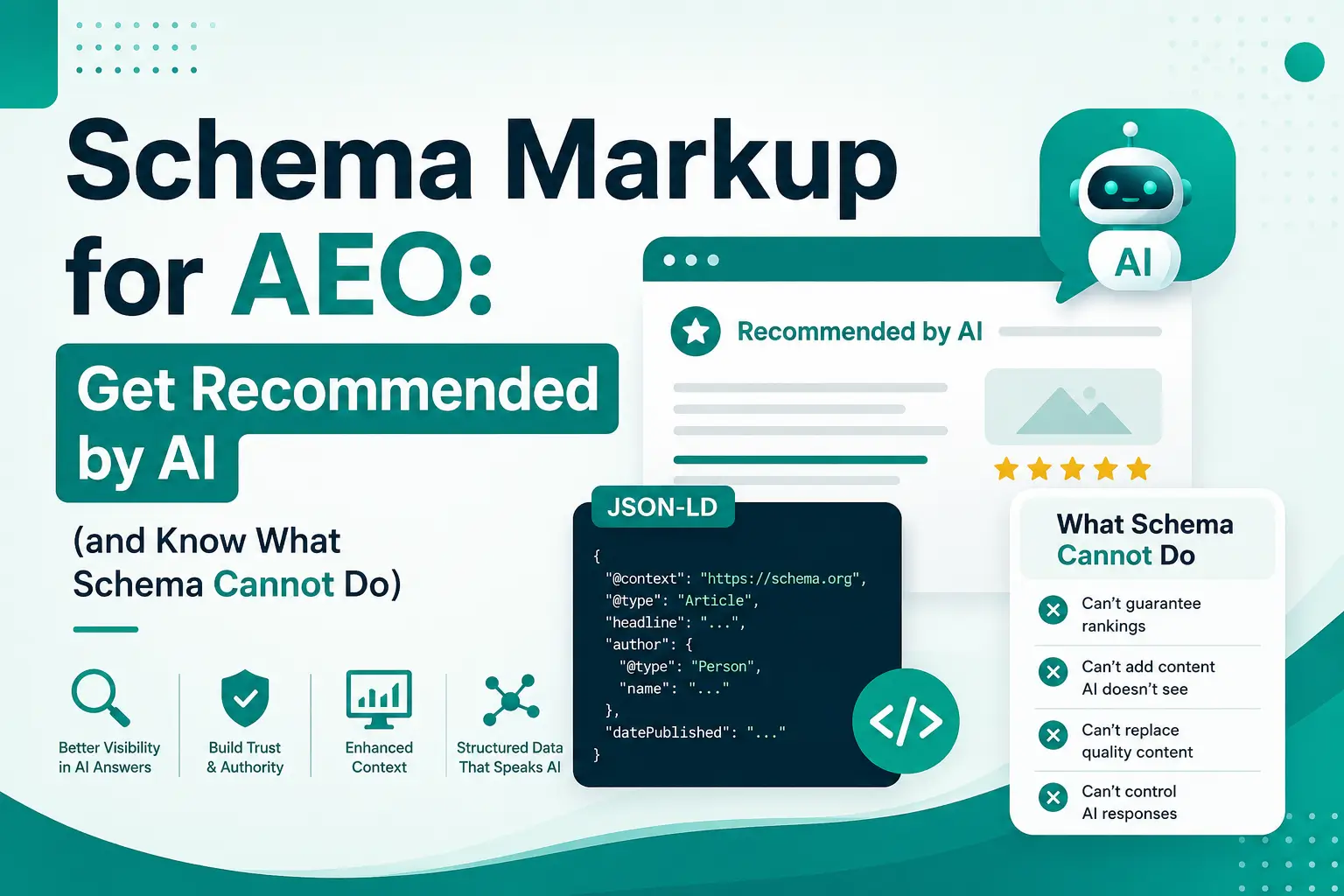
You asked ChatGPT or Gemini a question your business should own, and it recommended your competitors by name. Your site never came up. Somewhere along the way someone told you the fix is schema markup, so now you are staring at JSON-LD tutorials wondering what to install first. We implement schema for AI optimization on client sites every month, and the honest version is this: schema is worth doing, it is cheap, and it removes real ambiguity for machines. It is also not the lever most agencies claim it is. This article covers both halves, plus the exact types to implement first.
What Schema Markup Actually Does for AI Optimization
Schema markup is a machine-readable layer, written in JSON-LD, that states facts about your pages in a standard vocabulary. It declares that you are an Organization with this name and these social profiles, that a page is an Article written by this Person on this date, that these questions have these answers.
The role of schema in AEO is disambiguation, not persuasion. An answer engine assembling a response has to work out what your brand is, what you sell, who wrote the content, and how current it is. Unstructured prose forces the model or the retrieval system to infer those facts. Structured data states them outright, which reduces the chance you get misattributed, confused with a similarly named company, or described with stale information.
That matters most on Google’s AI surfaces. AI Overviews and AI Mode sit on top of Google’s index, and Google explicitly recommends structured data in its own structured data documentation. For ChatGPT and Perplexity the picture is weaker, because those systems lean primarily on the visible text they retrieve.
Schema is one piece of a wider discipline. If you have not read our plain-English guide to answer engine optimization, start there, because markup only amplifies content that already deserves a citation.
The Honest Evidence: Does Schema Get You Cited by AI
Here is where we part ways with most articles on this topic, including the ones selling schema retainers. The published evidence cuts both ways, and you deserve to see it before spending money.
The correlation is real. Ahrefs analysed roughly 6 million URLs and found that pages cited in AI answers were nearly three times more likely to carry JSON-LD than pages that were not. That number gets quoted everywhere as proof that markup earns citations.
The causal test says otherwise. In a controlled Ahrefs experiment running from August 2025 to March 2026, 1,885 pages that newly added schema were compared against about 4,000 matched control pages. Adding the markup produced no meaningful citation growth in ChatGPT or Google AI Mode. Well-maintained sites carry schema and get cited, but the tag itself was not the cause.
What does move citations is the visible content. The Princeton GEO study (KDD 2024) measured a lift of roughly 30 to 40 percent in citation likelihood when pages added specific statistics and named, cited sources to the text itself.
Our read, and the way we scope client work: treat schema as required plumbing that protects accuracy and supports Google’s AI features, and treat content quality plus entity consistency as the actual growth lever. Anyone promising AI citations from markup alone is selling ahead of the evidence.
The Most Important Schema Types for Answer Engine Optimization
You do not need forty schema types. In the sites we build out, six do nearly all the work, in this order.
| Priority | Schema type | Where it goes | What it does for AEO |
|---|---|---|---|
| 1 | Organization | Sitewide, global template | Defines your brand entity, name, logo, and profiles |
| 2 | Article or BlogPosting | Every editorial page | States topic, publish date, and dateModified for freshness |
| 3 | Person | Author pages and bylines | Ties content to a real expert, supports E-E-A-T |
| 4 | FAQPage | Pages with visible Q&A | Hands answer engines ready-made question and answer pairs |
| 5 | Service or Product | What you sell | Feeds vendor-recommendation and pricing answers |
| 6 | BreadcrumbList | Any page with breadcrumbs | Shows topical hierarchy and site structure |
Two notes on FAQPage, because it confuses people. Google cut FAQ rich results back in 2023, so this markup will rarely win you the old dropdown in search listings, and Search Console is retiring FAQ reporting in 2026. Keep it anyway where genuine Q&A content exists. Question-and-answer pairs are exactly the shape answer engines extract, and the markup costs nothing once the visible FAQ is written.
Local businesses should add LocalBusiness schema to this list ahead of Service, since geographic grounding is what gets you into “near me” style AI answers. We cover that in our guide to answer engine optimization for local business.
How Do I Implement Schema Markup for AEO
The mechanics are simpler than the tutorials make them look. Schema lives in a script tag of type application/ld+json, placed in the head of the page or output by your CMS. On WordPress, plugins like Rank Math or Yoast generate the basics; on custom builds, it belongs in the page templates.
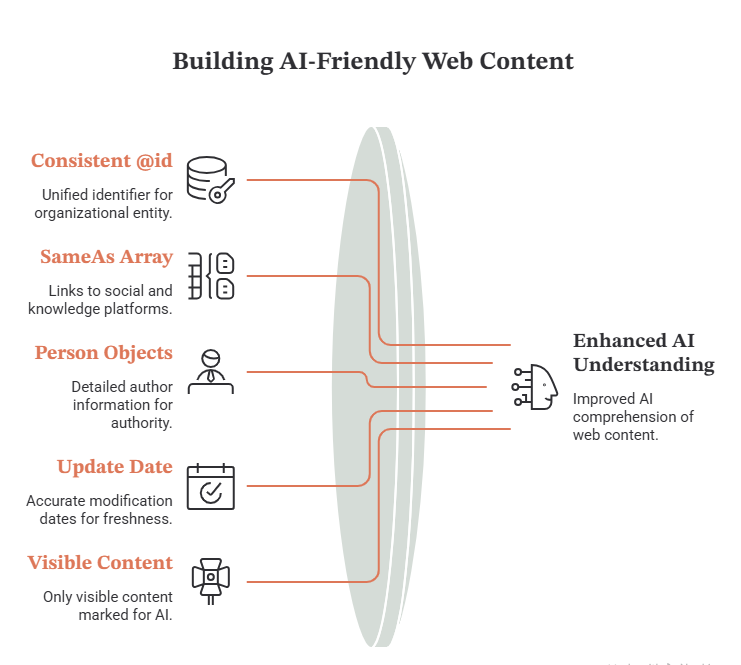
The implementation details that actually affect AI systems are these:
- Use one consistent @id for your Organization everywhere it appears, so every page points at the same entity rather than fragments of it.
- Fill the sameAs array with your LinkedIn, and where they exist, Wikipedia and Wikidata entries, since those are the platforms machines use to verify you are who you say you are.
- Mark authors up as full Person objects with a jobTitle, not as a bare name string, which carries no authority signal.
- Update dateModified only when you genuinely revise the page, because faked freshness is easy to detect and discount.
- Never mark up content that is not visibly on the page, including phantom FAQs and invented reviews.
Then validate every page with Google’s Rich Results Test and the Schema.org validator. Broken markup can be worse than none, because a malformed entity confuses the systems you were trying to help.
“Muhammad is an excellent SEO Expert. He totally understands SEO inside out and delivers results that actually make a difference. Crazy how optimizing our website and content started bringing us true, qualified leads right to our doorstep relatively quickly. Communication was easy, and he always kept me updated on progress. Very professional, knowledgeable, and reliable. I’d absolutely work with him again.” – Melissa Gerhold
What We Find When We Audit Schema on Real Sites
In most audits we run, the problem is not missing schema. It is broken or contradictory schema that the owner never knew was there. The typical culprit is two plugins both outputting markup, so the same page declares two different Organization entities with mismatched names, or an Article block whose author does not exist anywhere on the site.
A pattern we see constantly on WordPress builds: the theme ships its own structured data, the SEO plugin adds another layer, and a page builder adds a third. The result validates as three partial entities instead of one coherent brand. Cleaning that up, which usually means disabling all but one source and setting the brand details once, does more for machine understanding than adding any new type.
The second recurring finding is inconsistency between the schema and the rest of the web. Your markup says one business name, your Google Business Profile says another, and your LinkedIn says a third. Answer engines resolve entities across sources, so the disagreement lowers their confidence in all of them. Schema audits are part of every technical SEO audit checklist we run for exactly this reason.
FAQ
What is the role of schema in AEO?
Schema gives answer engines a machine-readable statement of who you are, what a page contains, who wrote it, and when it changed. Its job is disambiguation and verification rather than ranking. It helps AI systems describe you accurately and connect your pages to your brand entity, while the decision to cite you is driven mainly by the visible content and your authority across the web.
Does schema markup guarantee AI citations?
No. Controlled testing by Ahrefs in 2026 found that adding schema alone produced no measurable lift in ChatGPT or Google AI Mode citations, even though cited pages correlate strongly with having markup. Schema supports accuracy and Google’s AI features. Citations come from clear, specific, well-sourced content on trusted sites. Implement schema, but do not expect it to substitute for either.
Should I still use FAQPage schema after Google dropped FAQ rich results?
Yes, where real question-and-answer content exists on the page. The 2023 change removed most FAQ dropdowns from ordinary search listings, but answer engines still benefit from cleanly structured Q&A pairs, and the markup takes minutes once the visible FAQ is written. Just never mark up questions that do not appear on the page, since mismatches damage trust in your whole implementation.
How do I check whether my schema markup is working?
Run key pages through Google’s Rich Results Test and the Schema.org validator, then check the enhancement reports in Search Console for errors. Fixing what you find matters more than adding new types. For AI visibility itself, test manually: ask ChatGPT, Gemini, and Perplexity the questions your customers ask, note whether you are named, and repeat monthly to track direction.
Get Your Schema and AI Visibility Reviewed
If you want to know whether your markup is helping or quietly fighting itself, send us your domain through our technical SEO services page or the contact form. We will validate the structured data on your key pages, check how the major AI engines currently describe your business, and send back a prioritised fix list within a few working days. No retainer required, and you can action the list with your own developer if you prefer.