
Your rankings look fine, but your traffic keeps sliding, and last week a customer told you ChatGPT recommended your competitor by name. That combination is the most common reason business owners contact us right now. Nothing on your site broke. The place where buyers ask questions moved. AI engines now answer a growing share of queries directly, and if your business is not in the sources they pull from, you are invisible at the exact moment someone is ready to choose. This guide explains why that happens and what generative engine optimization actually involves, without the hype.
What Generative Engine Optimization Is and Why Your Traffic Moved
Generative engine optimization, usually shortened to GEO, is the practice of making your content easy for AI systems to find, understand, and cite when they build an answer. The targets are ChatGPT, Google’s AI Overviews and AI Mode, Perplexity, Gemini, Copilot, and Claude.
Traditional SEO gets you a position on a results page. GEO gets you into the answer itself. When someone asks “who is the best accountant for small ecommerce businesses,” a generative engine retrieves a handful of pages, weighs them, and writes one response naming two or three providers. Either you are in that handful or you are not. There is no page two.
The term comes from a 2023 study by researchers at Princeton, Georgia Tech, and the Allen Institute, published as Generative Engine Optimization on arXiv. They tested nine content changes across 10,000 queries and found that adding citations, quotations from credible sources, and specific statistics improved a page’s visibility in AI answers by up to 40 percent. That paper is still the closest thing this field has to controlled evidence, and its findings match what we see in client work.
Why AI Engines Skip Some Sites and Cite Others
Generative engines do not read your site the way a person does. Most of them run a retrieval step first: they issue searches, pull the top results, then extract passages that directly answer the question. Two consequences follow from that, and both explain most visibility problems we diagnose.
First, you usually cannot be cited by AI if you are not retrievable in the first place. Research shared by Seer Interactive in early 2026 found that the large majority of ChatGPT’s cited sources came from the top twenty positions of Google and Bing. Your existing SEO is the entry ticket. If your technical SEO foundation is weak, or AI crawlers like GPTBot and PerplexityBot are blocked in your robots.txt, no amount of content polish will help.
Second, retrieval works at the passage level, not the page level. The engine lifts the paragraph that answers the question. A page can rank well and still never get cited because its answer is smeared across 900 words of warm-up. Clear, self-contained passages win.
In Most Sites We Audit, the Problem Is Not Content Quality
Here is the pattern we keep running into. Owners assume they need more content or better writing. In most of the sites we audit for AI visibility, the content already contains the right answer. The problem is that the answer is buried. The direct statement a machine could quote sits in the second half of a long paragraph, after three sentences of preamble, under a heading that does not match how anyone phrases the question.
The second most common cause is missing evidence. Pages make claims with no numbers, no named sources, and no author attached. The Princeton study measured exactly this: pages with statistics and cited sources got picked up far more often than fluent pages without them. AI engines are trained to prefer passages that look verifiable.
A distant third is technical blocking, but when it appears it is total. We have opened robots.txt files that blocked every AI crawler because a plugin default was never reviewed. Those sites had zero chance of appearing in ChatGPT answers regardless of quality. Checking that file takes two minutes and we do it first in every audit.
Muhammad was extremely helpful, responsive, clear, and comprehensive. I will absolutely use his service again and appreciated his support on my Shopify website project. ” Kim Walls”
GEO vs SEO: What Changes and What Stays the Same
GEO does not replace SEO. It sits on top of it. The table below shows where the two overlap and where the work genuinely differs.
| Area | Traditional SEO | Generative Engine Optimization |
|---|---|---|
| Goal | Rank a page in the results list | Get cited or named inside the AI answer |
| Unit of optimization | The page | The passage or claim |
| Key signals | Links, relevance, page experience | Retrievability, quotable structure, evidence, entity clarity |
| Success metric | Positions, clicks | Mentions, citations, share of voice in AI answers |
| Measurement | Search Console, analytics | Prompt testing, AI visibility tools, referral traffic from AI domains |
| Failure mode | Page two of Google | Left out of the answer entirely |
The overlap is bigger than most vendors admit. Strong rankings feed AI retrieval, which is why abandoning SEO for GEO is the one mistake that reliably backfires.
What Actually Improves AI Visibility
Everything below is grounded in either the published research or patterns we can stand behind from client work. Nothing here requires new software.
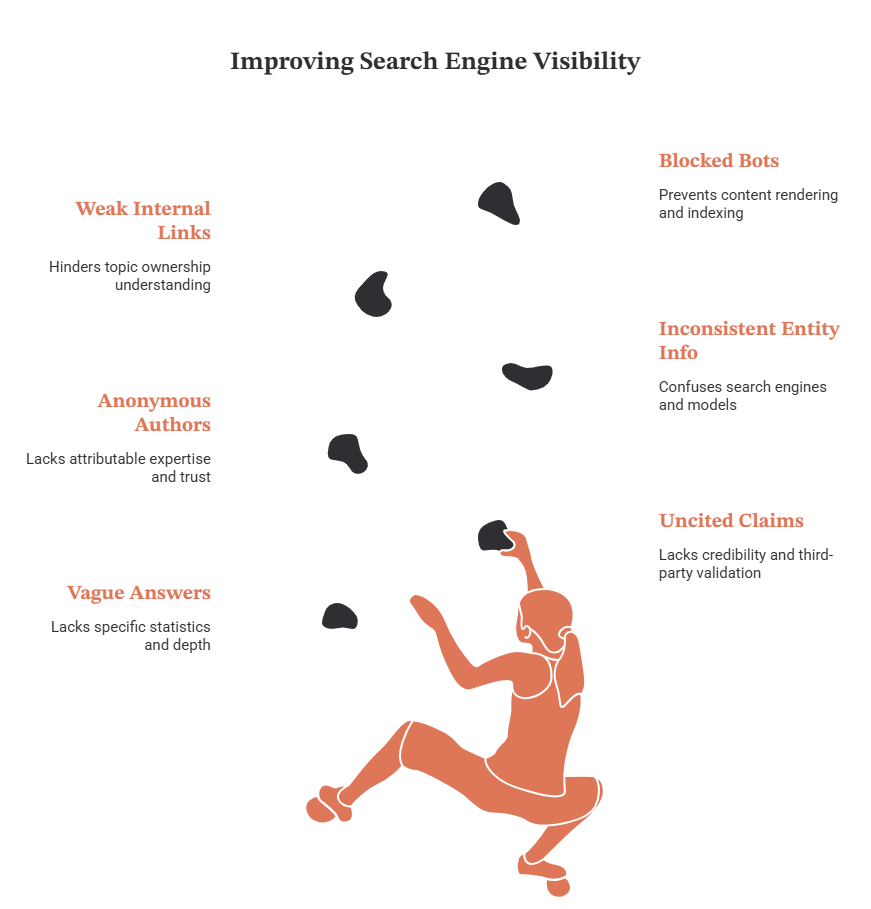
- Answer the question in the first two sentences under each heading, then add depth. Write headings as the questions people actually ask.
- Add specific statistics with named sources. “Response time matters” gets ignored. “Our average first response is under 4 hours” gets quoted.
- Quote credible third parties and cite where claims come from. Citation density was one of the strongest levers in the arXiv study.
- Put a named author with real credentials on every substantive page. Engines and the search results feeding them both favor attributable expertise.
- Keep entity information consistent. Your business name, services, and location should read identically across your site, Google Business Profile, and major directories, so models resolve you as one clear entity.
- Strengthen internal connections between related pages so retrieval systems understand topic ownership. We covered the mechanics in our guide to internal linking for SEO and GEO.
- Confirm GPTBot, ClaudeBot, PerplexityBot, and Google-Extended are not blocked, and that your pages render their main content without JavaScript where possible.
If your pages need restructuring to support this, that is standard on-page SEO work, just aimed at a second audience of machines.
How to Measure Whether GEO Is Working
You cannot see most AI visibility in Google Analytics, which is why owners often feel the loss before they can measure it. A workable measurement routine has three parts.
Run a fixed set of prompts monthly. Write ten to fifteen questions your buyers would ask, run them in ChatGPT, Perplexity, and Google’s AI Mode, and record whether you are named or cited. Answers vary between runs, so look for trends across months, not single results.
Segment AI referral traffic. Set up a channel group for visits from chatgpt.com, perplexity.ai, gemini.google.com, and copilot.microsoft.com. Volumes are usually small, but across the accounts we manage these visitors tend to arrive far better informed and convert at a noticeably higher rate than average organic visitors, because the AI already did the comparison for them.
Watch branded search. When AI engines mention you without linking, people search your name afterward. A rise in branded impressions alongside flat generic clicks is often GEO working.
Where GEO Fits Next to Answer Engine Optimization
You will see GEO and AEO used almost interchangeably, and the honest answer is that they overlap heavily. Answer engine optimization grew out of optimizing for featured snippets and voice answers. GEO extends the same thinking to systems that write original responses from multiple sources. The tactics converge: direct answers, evidence, clean structure, strong entities. We break down the snippet-and-answer side separately in our guide to answer engine optimization, and if you serve a specific area, the local version of this work has its own quirks around Google Business Profile and review signals.
One caution while the field is young. GEO tooling is multiplying fast and some vendors promise guaranteed placement in AI answers. Nobody can guarantee that. The engines change retrieval behavior without notice, answers vary run to run, and anyone selling certainty is selling something else.
FAQ
What is generative engine optimization in simple terms?
It is the work of making your website easy for AI tools like ChatGPT, Perplexity, and Google’s AI Overviews to find, understand, and quote. Instead of only competing for a ranking position, you are competing to be one of the sources an AI names when it answers a buyer’s question.
Is GEO replacing SEO?
No. The evidence points the other way: AI engines mostly pull their sources from pages that already rank well in Google and Bing. SEO gets you retrieved, GEO gets you quoted. Treat them as one program with two audiences, human readers and machine readers, rather than a budget fight.
How do I get my business mentioned in ChatGPT?
Rank for the underlying searches, allow AI crawlers in robots.txt, and publish pages that answer buyer questions directly with specifics, statistics, and named authors. Consistent mentions on third-party sites, directories, and review platforms also matter, because models lean on the wider web to decide which businesses exist and who they serve.
How long does generative engine optimization take to show results?
Expect the first measurable movement in roughly two to four months, usually as citations for specific questions rather than across the board. Timelines depend heavily on your existing rankings and authority, so a site already on page one moves much faster than one starting from nothing. Anyone quoting a fixed date is guessing.
Does blocking AI crawlers protect my content?
It keeps your pages out of those AI systems, which also removes you from their answers. That is a legitimate business choice for publishers who sell content. For a business that wants customers to find it, blocking GPTBot or PerplexityBot mostly protects your competitors.
Find Out Where You Stand in AI Answers
If you suspect AI answers are costing you customers, the useful first step is knowing your current position, not committing to a retainer. Send us your site through our contact page and we will run a short AI visibility check: your rankings for the queries that feed retrieval, your crawler access, and whether you currently appear for ten buyer prompts. You get a plain-language summary of what is holding you back and what to fix first, typically within a few working days.