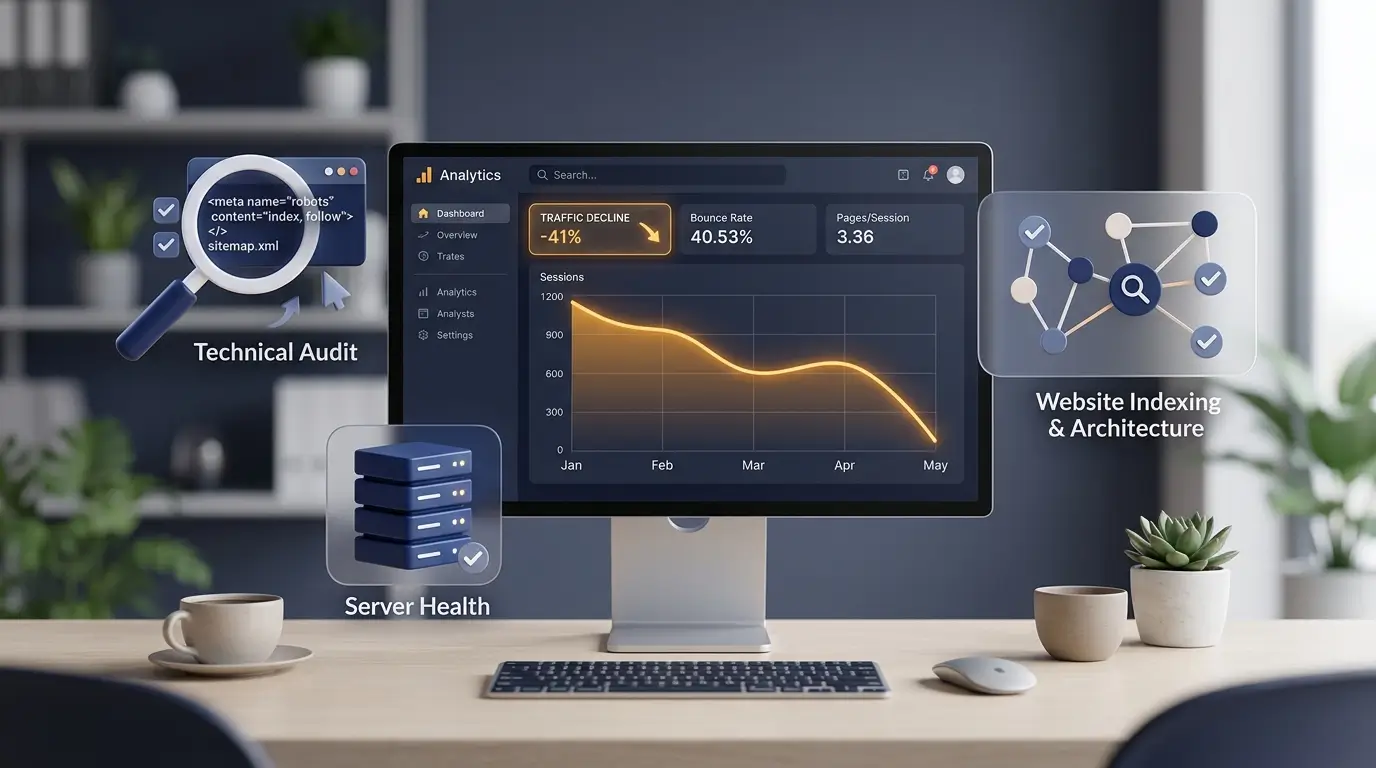
Your Magento store was ranking fine. Then the graph in Search Console bent downward, product pages started falling out of results, and revenue followed a fortnight later. If you are looking for a magento seo expert this week, that is usually the sequence. Nothing was announced. Nothing looks broken on the front end. The store loads, checkout works, and your developer is certain nothing changed. The cause is almost always something Google can see and you cannot, and nine times out of ten it is sitting in your indexed URL count.
Start with your indexed URL count, not your keywords
The first number I pull on a Magento store is the ratio of indexed URLs to actual products. A store with 4,000 SKUs showing 90,000 pages in the Search Console Pages report is not a mystery to solve. It is a store that has told Google to spend its crawl budget on filters.
Those extra URLs come from a predictable set of places:
- Layered navigation filter combinations, one crawlable URL per combination
- Sort orders and pagination parameters on category pages
- Internal search results pages that got linked from somewhere
- The same product reachable through several category paths
- Session IDs and tracking parameters appended to clean URLs
- Empty or out of stock filter results that return near identical pages
When 90 percent of your crawlable URLs are near duplicates of a category page, Google’s recrawl of the pages that actually sell gets slower and less frequent. New products take weeks to appear. Existing category pages compete against filtered versions of themselves. The drop looks sudden, but it built up over months. A proper technical SEO audit starts here rather than with keyword gaps.
Layered navigation is doing exactly what it was configured to do
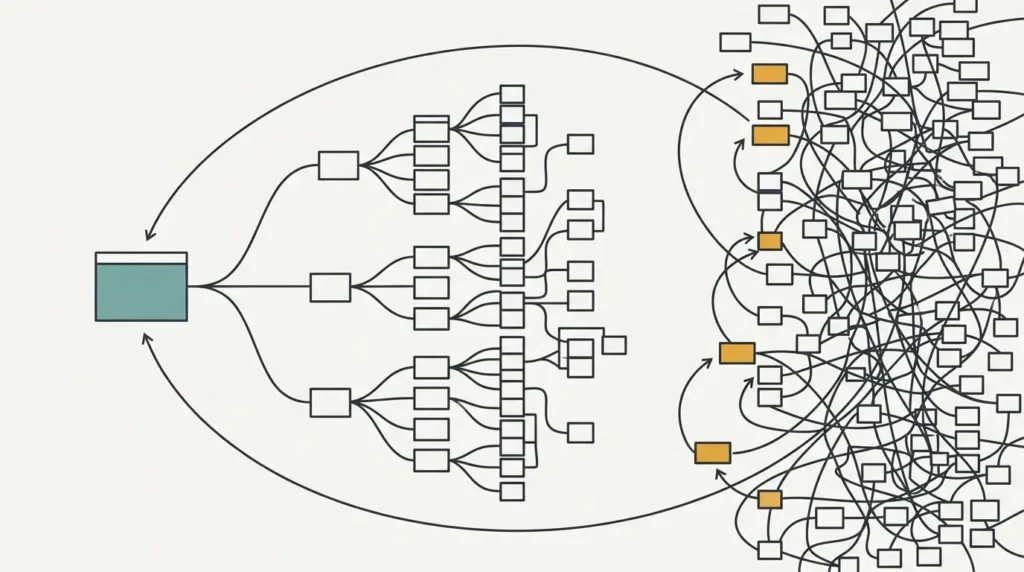
This is worth understanding, because it changes what you ask your developer for. Magento generates a filter link for every attribute value you mark as filterable in layered navigation. Five attributes with six values each do not produce 30 URLs. They produce every combination of those values, and the count runs into the thousands before you have added a second store view.
The fix is a set of rules, not a switch:
- Decide which filter pages deserve to be indexed. A brand plus category page with real search demand and a healthy product count can earn its place. A colour plus size plus price band page cannot.
- Canonical everything else back to the parent category URL.
- Use noindex, follow on the filtered pages you want out of the index while keeping the link equity flowing.
- Leave robots.txt alone at this stage. Blocking a URL in robots.txt stops Google recrawling it, which means it never sees the noindex tag and the page stays in the index. I see this mistake on roughly half the stores that arrive already “fixed”.
The same principle applies to configurable products. Variants should canonical to the parent product page unless a variant genuinely targets a different query, such as a specific model number people search by name.
Muhammad delivered excellent work on this SEO and optimization project, and I truly enjoyed working with him. Over the course of our 8-month collaboration, his strategies led to over 400% increase in customer leads – helping us outperform even larger competitors in our saturated industry. I highly recommend Muhammad, and will absolutely work with him on other projects too when they will come out. ” Alessio Ligabue, Upwork”
Mobile speed is the second cause, and it hides from desktop testing
If the index looks clean and traffic still fell, I go to field data rather than lab scores. Magento stores routinely pass a desktop Lighthouse run and fail real world mobile performance, because the numbers that matter come from actual visitors on actual connections.
Three things account for most of it: time to first byte on uncached category pages, third party scripts loaded in the head, and the JavaScript weight the Luma theme ships by default. Interaction responsiveness on filter clicks is the metric most stores never look at.
The commercial case is well documented. In the Deloitte and Google study Milliseconds Make Millions, a 0.1 second improvement in mobile site speed was associated with retail conversions rising 8.4 percent and average order value rising 9.2 percent across 37 brands and more than 30 million sessions. That is a tenth of a second. Our guide to Core Web Vitals covers which of those metrics actually move rankings and which mostly move revenue.
Match your symptom to the likely cause
| What you are seeing | What it usually means | Where to check first |
|---|---|---|
| Gradual decline over 6 to 12 weeks, no manual action | Index bloat competing with your category pages | Search Console Pages report, indexed versus submitted |
| Product pages indexed but not ranking for their own product name | Duplicate URLs from category paths or variants | Search the exact SKU on Google, then inspect canonicals |
| Whole categories disappeared after a redesign or migration | URL rewrites regenerated, old paths now 404 or chained redirects | Crawl the old sitemap, check for redirect chains |
| Rankings held steady but sales fell | Mobile speed and interaction delay | Core Web Vitals report, field data not lab data |
| New products take weeks to get indexed | Crawl budget consumed by filter URLs | A sample of server log files |
None of these is a diagnosis on its own. They tell us where to look, and they tell you what to ask for when you hire a magento seo specialist so you are not paying someone to run a generic audit.
What the first 30 days look like
I work in the same order every time, because the sequence matters. Fixing content before crawling is fixed wastes both.
- Week one. Full crawl, a sample of server logs, Search Console exports going back 16 months, and a call with whoever owns the codebase. You get a prioritised list of findings, ranked by revenue impact rather than by severity score.
- Week two. Canonical and indexation rules for layered navigation, category paths, and variants. Most of this is configuration and template work rather than custom development.
- Week three. Performance. TTFB, full page cache behaviour, script loading, image delivery on category pages.
- Week four. Templates and structured data. Product schema, unique metadata patterns that scale across the catalogue, internal linking from categories to the products that need it.
Not every store needs all four weeks. Some need a two day fix and no retainer, and I will tell you that on the first call rather than after you have signed something. Magento ecommerce experts who insist every store needs a twelve month engagement have not looked at your store yet.
Working with Muhammad has been a key driver in obtaining new leads for our B2B SaaS product. I am extremely happy with his SEO expertise and content writing, and would highly recommend him. For founders looking for a solid GTM strategy or continuing service, Muhammad is your guy!!! ” Brandon Parham”, Upwork
What we will not promise you
No one can guarantee a ranking position, and anyone who does is selling you something they cannot control. Here is what the honest version looks like.
Index cleanup shows up slowly. Google has to recrawl the URLs you have noindexed before they drop out, and on a bloated store that can take six to twelve weeks. Speed work tends to show in conversion data faster than in rankings. If your decline started on the same date as a core algorithm update, the diagnosis changes and so does the work, because that is a content and site quality problem rather than a crawl problem.
The one thing I can commit to is that you will know what is wrong before you spend money fixing it.
FAQ
How long does recovery take after the fixes go live?
It depends on how much of the index needs clearing and how often Google crawls your store. Speed improvements register within days. Indexation changes typically take six to twelve weeks to fully reflect, longer on large catalogues with slow crawl rates. Anyone quoting you a fixed recovery date is guessing.
What does it cost to hire a Magento SEO specialist?
Published rates across the market run from a few hundred dollars for a one off audit to several thousand a month for ongoing work on enterprise catalogues. The variable is catalogue size and whether implementation is included or handed to your developers. Ask for a scoped quote against your actual store, never a package price.
Does it matter where the specialist is based?
Not technically. Crawl rules, canonicals, and page speed work the same everywhere. Businesses searching for magento seo specialists london or a magento seo expert for hire in their own city usually want overlapping working hours and someone who will join a call with their dev team. Both are reasonable to ask for. Neither requires the same postcode.
Can our Magento developer do this instead?
Often, yes, once someone has told them exactly what to change. Developers implement I’ll and diagnose search problems less often, because it is not what they do daily. The split that works best is us writing the specification and your developer shipping it, which is usually cheaper than paying an agency to do both.
Send us the URL and I will look
If your store has lost traffic and you want a straight answer about why, send the URL through the contact form or book a 30 minute call. I run a crawl before I speak, so the call starts with findings rather than questions. You leave with a written list of the three things costing you the most traffic and a rough estimate of the work each one takes, whether you hire us or hand it to your own team. No charge for that part. More detail on the ongoing work is on our Magento SEO consultant page.
About Author:
Written by Muhammad Saif ul Haq
Technical SEO Consultant · 8+ years · 250+ projects delivered
Saif is an independent technical SEO consultant specialising in crawl, indexing and site architecture problems on complex ecommerce builds, including Magento and Adobe Commerce catalogs. He works with clients globally from seowithsaif.com.