Your roofing website used to bring in a steady run of quote requests. Now the phone is quieter, even though nothing on the site looks broken. When I see this pattern in SEO for roofers, the cause is rarely a penalty or a hack. It is usually the content itself: thin city pages, outdated blog posts, and several pages fighting over the same search. A content audit is how you find out which pages are earning you jobs and which ones are holding the rest of the site back.
What a Content Audit Actually Is, in Roofing Terms
Think of it as a roof inspection for your website. You don’t tear everything off because one area leaks. You check every section, mark what is sound, what needs patching, and what has to go.
A content audit is a page-by-page review of every URL Google has indexed on your site. For each one, I pull:
- Search Console data: clicks, impressions, and average position over the last 12 months
- Lead data: form fills and tracked calls from GA4 or your call tracking tool
- Backlinks: whether any outside sites link to that page
- Content quality: word count, last updated date, and whether it answers a real customer question
- Target query: which search the page is actually trying to rank for
Every page then gets one decision: keep, improve, merge, or remove.
This matters because most pages on most websites do nothing. An Ahrefs study of over a billion pages found that 96.55% of them get zero organic traffic from Google. Roofing sites are no exception. In my experience they tend to be worse, because so many are built from templates.
Why Roofing Websites Quietly Lose Leads
Google does not judge your pages one at a time in a vacuum. Its core ranking systems use some site-wide signals, and its guidance on helpful, people-first content is clear that a site carrying a lot of low-value material can struggle as a whole. So 40 weak pages can drag down the five that should be ranking.
Here is what I find on the roofing and home-service sites I audit, again and again:
- Swapped-city pages. “Roof Repair in Aurora” and “Roof Repair in Lakewood” with identical text and only the town name changed. Google’s spam policies specifically call out doorway pages built this way.
- Self-competition. Three blog posts about roof replacement cost, all competing with the actual roof replacement service page. Google picks one, often the wrong one.
- Stale storm content. Hail season posts from years ago with outdated insurance advice and no links pointing to them.
One honest point: on a 60-page roofing site, crawl budget is not your problem, whatever some reports claim. The problem is quality dilution and pages competing with each other. That is a content issue, and it is the most common reason I see when owners ask why their SEO stopped producing calls.
Muhammad delivered excellent work on this SEO and optimization project, and I truly enjoyed working with him. Over the course of our 8-month collaboration, his strategies led to over 400% increase in customer leads – helping us outperform even larger competitors in our saturated industry.
Alessio Ligabue, Services Provider (Italy)
The Pages a Content Audit Usually Finds on Roofer Sites
Most roofing websites fall into the same handful of page types. Each one tends to need a different decision, which is why a blanket “add more content” plan rarely works.
| Page type | What I usually find | Typical decision |
|---|---|---|
| Core service pages (repair, replacement, inspection) | Thinner than the blog posts, weak on proof and pricing context | Improve |
| City or service-area pages | Templated, near-duplicate text across 20 to 80 pages | Merge into fewer, genuinely local pages |
| Old blog posts | Outdated, no traffic, no backlinks | Remove or redirect |
| Blog posts with traffic but no leads | Ranking for informational searches, no path to a quote | Improve with internal links and a clear next step |
| Project gallery or case study pages | Photos only, no written context | Improve with job details and location |
The decision rule is simple once the data is in front of you. If a page gets traffic or leads, keep it and strengthen it. If it overlaps with a stronger page, merge it and redirect the old URL. If it has no traffic, no links, and no realistic purpose, remove it.
How I Run a Content Audit for a Roofing Company
The process is the same whether the site has 30 pages or 300. What changes is how many judgment calls the data leaves open.
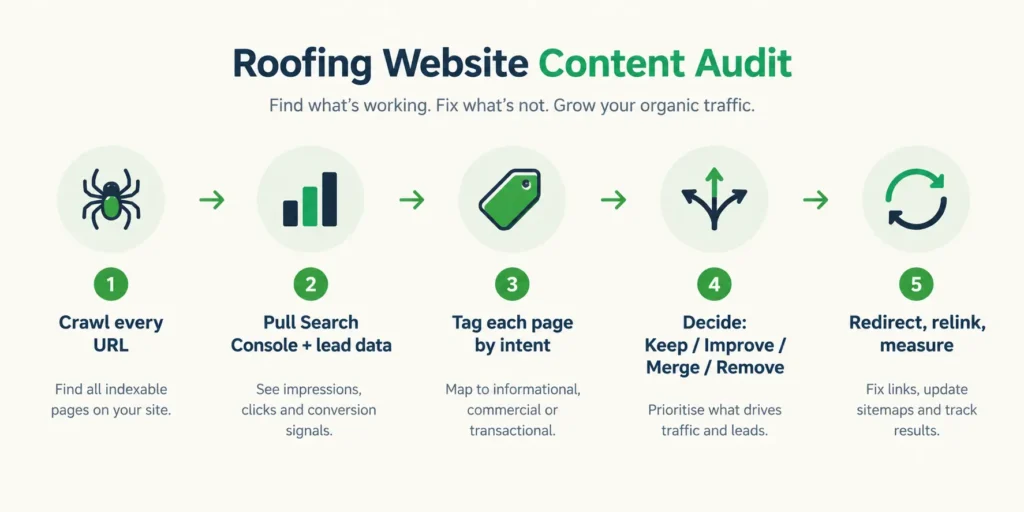
- Crawl and export. I crawl the full site and compare it against what Google has indexed. Mismatches here often reveal technical problems worth checking first, like orphaned pages or stray parameter URLs.
- Match pages to real data. Search Console clicks and impressions, plus calls and form fills. A page with low traffic but two quote requests a month is worth more than a page with 500 visits and none.
- Group by search intent. Someone searching “roof leak repair near me” wants a roofer today. Someone searching “how long does a shingle roof last” is researching. Both pages can earn their place, but they need different jobs.
- Make the decisions. Keep, improve, merge, or remove, page by page.
- Redirect and relink. Every merged or removed URL gets a 301 to its closest match, and the surviving pages get stronger contextual links between them.
- Measure. I compare the same metrics 8 to 12 weeks later, not 8 days later.
The improve step is where most of the real work sits. That usually means rewriting service pages properly with local proof, real project details, and answers to the questions homeowners actually call about.
Muhammad was extremely helpful, responsive, clear, and comprehensive. I will absolutely use his service again and appreciated his support on my Shopify website project.
Melissa Pepers, Upwork client
What to Expect After the Audit
I won’t promise rankings, and you should be wary of anyone who does. What I can tell you is the pattern I usually see.
Google typically recrawls the changed pages within a few weeks. Ranking movement, when it comes, tends to show over roughly two to four months, depending on how competitive your area is and how much was cut or rewritten. A site in a dense metro competing with national lead-gen brands will move slower than one in a mid-size town.
Be clear on the limits too. A content audit fixes content problems. It won’t fix a neglected Google Business Profile, a thin review count, or a missing map pack presence. Those sit alongside your website, and for roofers the map pack side of local search often drives as many calls as organic results do.
If your traffic fell sharply around a Google core update rather than sliding slowly, the audit becomes part of a wider recovery plan rather than the whole fix.
FAQ
What is a content audit?
A content audit is a full review of every page on your website, measured against traffic, rankings, leads, and quality. Each page ends up with one decision: keep it, improve it, merge it with a similar page, or remove it. For a roofing company, the goal is a smaller set of pages that each have a clear job, so Google knows exactly which page to show for each search.
How much does it cost to hire someone for SEO?
It varies widely with scope. A one-off content audit for a small roofing site costs far less than ongoing monthly SEO, which can run from a few hundred to several thousand dollars a month depending on the market and who you hire. Ask what you will actually receive: a page-by-page decision list and redirect plan is worth paying for. A generic PDF of tool screenshots is not.
Is SEO still worth it for roofers in 2026?
For most roofing companies, yes. Homeowners still search Google when a roof leaks or a storm hits, and those searches carry high intent. What has changed is that thin, templated content works far less well than it used to, and AI answers now sit above some results. Sites with genuinely useful, locally specific pages are the ones still picking up those calls.
How often should a roofing company audit its website content?
A full audit once a year is enough for most roofing sites, with a lighter check after any big change, such as a redesign, a new service line, or a sharp traffic drop. If you publish a lot of blog content, review it every six months so outdated posts don’t pile up and start competing with your service pages.
Can I do a content audit myself?
You can do a basic version with Google Search Console and a spreadsheet: list your pages, note clicks over the last 12 months, and flag anything with zero clicks and no clear purpose. The harder part is judging merges and redirects without losing pages that quietly bring in leads. That judgment is where outside help usually earns its fee.
Not Sure Which Pages Are Costing You Calls?
If your roofing site has slowed down and you can’t tell why, the easiest first step is to send me your site through my contact page. I’ll look at your Search Console data with you, point out the pages most likely holding the site back, and tell you honestly whether a full audit is worth doing or whether the problem sits elsewhere. You walk away with a clear next step either way, with no obligation to hire me.