Stockton SEO problems usually show up the same way: the phone stops ringing. Your business used to get steady calls from Google. Now competitors sit above you, website inquiries have slowed, or your Google Maps listing seems to have vanished for searches you used to win.
I would not automatically blame a Google algorithm update. A drop in local leads can come from several different problems, and each one needs a different fix. If you do suspect an update, here is how I check whether one actually hit a site.
Before you spend more on SEO services, you need to know one thing: have customers stopped finding your business, or are they finding it and choosing not to contact you? That answer decides where I start.
Why Stockton is a harder local market than it looks
Stockton is not a small town with three competitors per trade. The US Census Bureau counts 320,804 residents spread across roughly 62 square miles. That size creates problems a generic local SEO checklist does not cover.
Distance works against you inside the city. A customer searching from Spanos Park in the north and one searching from Weston Ranch in the south can see different businesses for the same search. Ranking well near your own address does not mean you are visible across Stockton.
You compete with the cities around you. Businesses in Lodi, Manteca, Lathrop and Tracy target Stockton customers, and Stockton businesses often want work in those cities too. Your real competition is rarely limited to the city boundary.
Not every customer searches in English. The same Census data shows that 46.3% of Stockton residents aged five and over speak a language other than English at home. If your website and Business Profile only answer English searches, you may be invisible to a large share of the people who need your service.
Much of the SEO help on offer is not local. Search for Stockton SEO services and a large share of what comes back is national agencies with a Stockton landing page, plus directory lists. That is not a problem in itself. I work remotely too, and I say so. The problem is paying for a “local” plan that is the same template sold in every city.
Where are your leads being lost? Start here
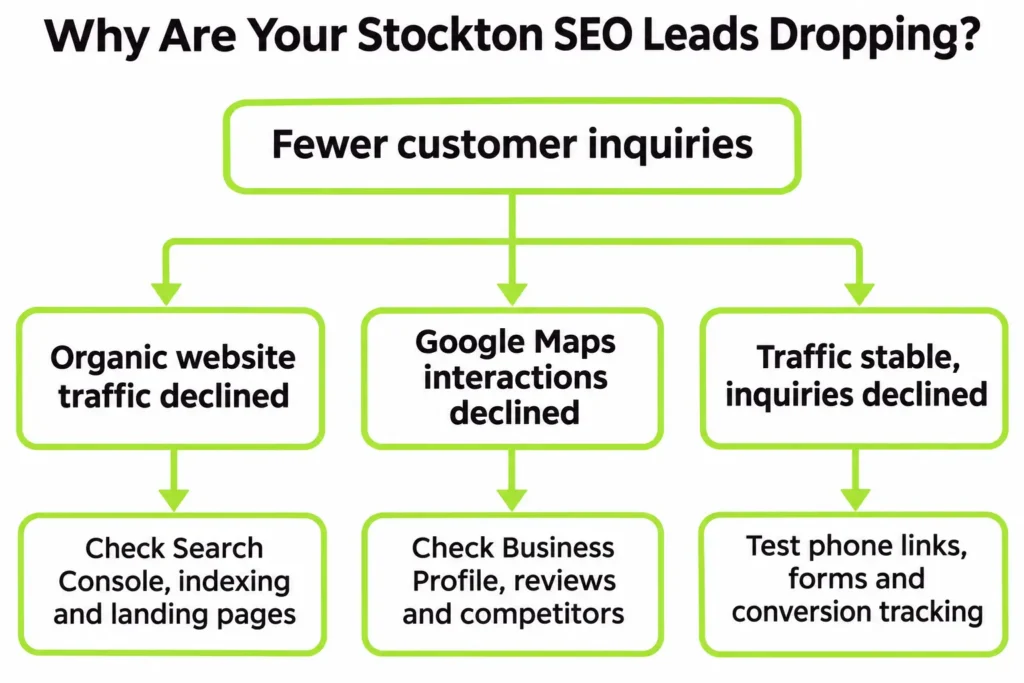
The first thing I work out is where the decline is happening. A Stockton business can lose organic website traffic while its Google Business Profile keeps receiving calls. The opposite happens too.
I separate these problems because Google Search and Google Maps do not rank businesses in exactly the same way.
| What you are seeing | What it usually means | Where I check first |
|---|---|---|
| Website impressions and clicks are both falling | Pages have lost visibility, been affected by a technical change, or stopped matching what people search for | Google Search Console: pages, queries and indexing |
| Impressions are steady but clicks are falling | Your positions, your titles, or the results around your listing have changed | Search Console: average position and the live results page |
| Traffic is steady but inquiries are falling | The problem is on the site: forms, phone links, mobile experience or messaging | Forms, click-to-call links and conversion tracking |
| Google Maps calls and direction requests are falling | Your Business Profile, reviews, local competition or customer location has changed | Business Profile performance data and competitor listings |
Search Console shows how the website is performing. Business Profile performance data shows what is happening in Maps. Google Analytics shows what visitors do after they arrive. I need all three before I recommend anything.
Why your Stockton business stopped showing on Google Maps
When an owner tells me their Maps ranking has dropped, I check more than the listing itself.
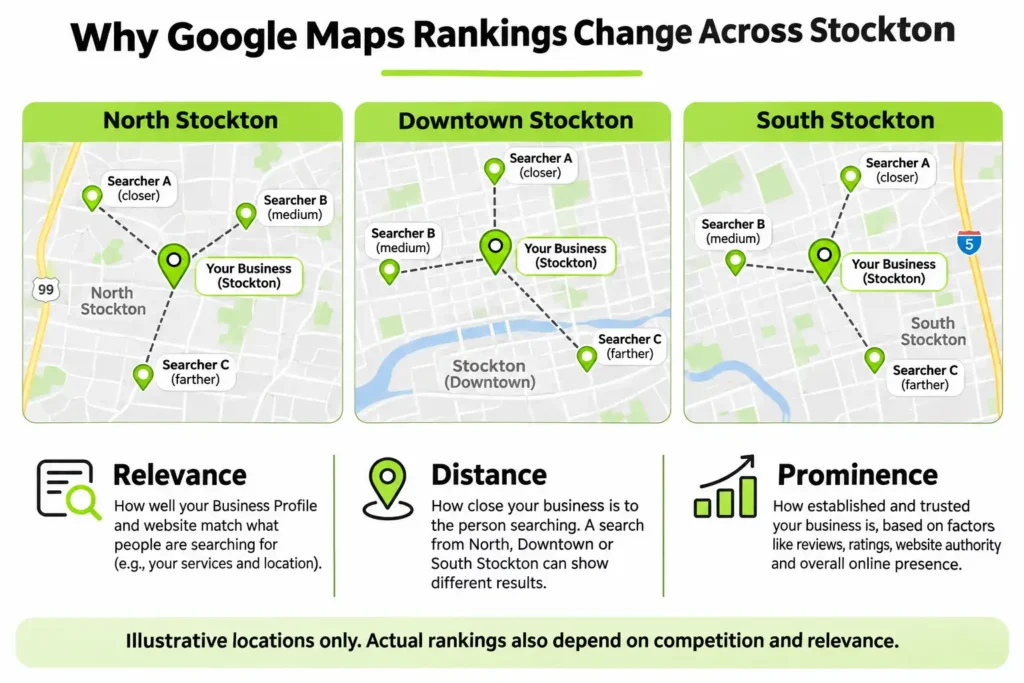
Google names three main factors for local rankings: relevance, distance and prominence. You can read them in Google’s own local ranking guidance.
Relevance is how closely your business matches the search. A roofing company whose primary category and website clearly describe its roofing services is a better match for roofing searches than a business with vague service information.
Distance changes the results depending on where the customer is. Someone searching in Brookside can see different businesses than someone searching downtown, even for the same words.
Prominence is how established and well known your business is. Google looks at links, reviews and other references to the business.
Reviews deserve a closer look, because customer expectations have moved. In the BrightLocal Local Consumer Review Survey 2026, 74% of consumers said they only care about reviews written in the last three months, and 47% said they would not use a business with fewer than 20 reviews. A profile with strong reviews from two years ago is no longer doing the job it used to.
The pattern I find most often is a mismatch between the Business Profile and the website. The listing describes a specific service, but it links to a generic homepage that barely mentions it. That is a relevance problem, and adding more keywords to the business description will not fix it.
I also check for:
- A primary business category that is wrong or too broad.
- Changes to the address, service area or verification status.
- Inaccurate opening hours and outdated contact details.
- Review recency and quality compared with the businesses now ranking above you.
- Thin or missing service information on the page the listing links to.
One restriction matters here. Your listing must use genuine location information. Adding a virtual Stockton office, or creating listings for addresses where you do not operate, can violate Google’s guidelines and get the listing suspended.
For more examples, see the profile errors that quietly push a listing down.
Why website traffic can drop while your Business Profile looks fine
A fall in traditional search traffic needs a different investigation.
One of the first things I look for is an important page becoming unavailable to Google after a website update. A developer can add a noindex directive by accident, change a canonical URL, remove an internal link, or redirect a valuable service page to a less relevant one. The site looks normal to customers while Google receives different instructions.
Standard reports often miss this. One services client came to me after a core update with agency reports that still said the site was healthy while clicks kept sliding. The problems were structural, and they did not show up as red errors in a routine report. Once they were fixed in order, organic clicks rose by 164%.
I start by comparing search performance before and after the decline. Google’s guide to diagnosing traffic drops recommends reviewing historical trends, affected pages, queries and indexing issues. It also explains how the 16 months of data in Search Console can reveal seasonal patterns, which matters for trades with a busy season.
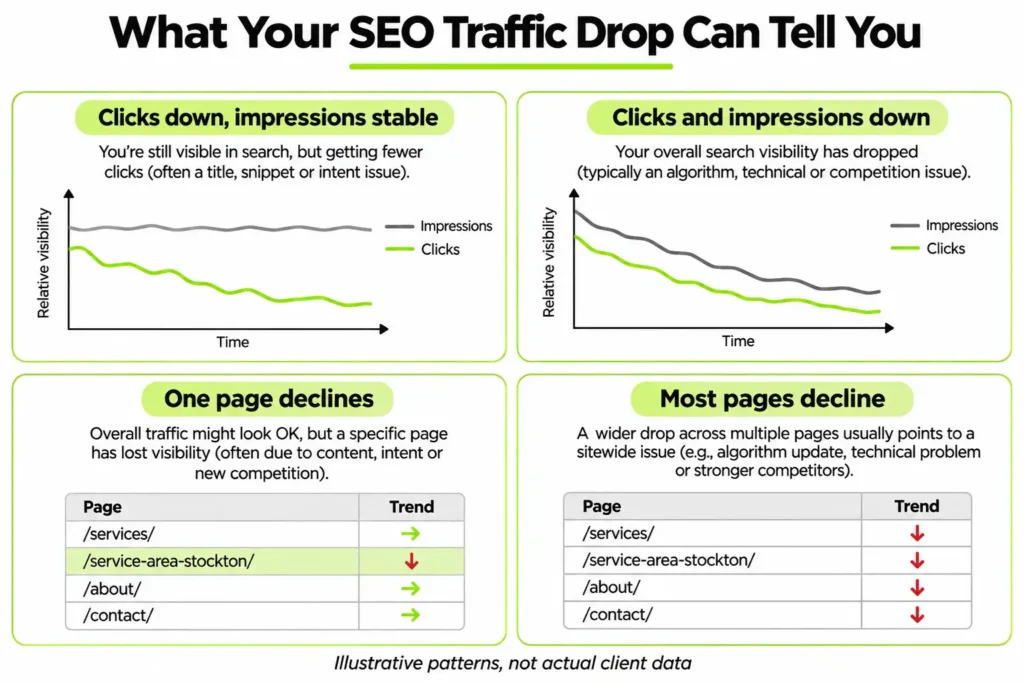
The shape of the drop tells me where to look:
- Only one service page declined: I check indexing, competitors, search intent, internal links and recent content changes on that page.
- Several related service pages declined: I look at overlapping targeting, site structure and anything that changed in that section.
- Most pages declined together: I examine technical access, migrations, broader ranking changes and seasonal demand.
- Rankings held but clicks fell: I review how the result appears in search, query demand and changes in click behavior.
I also look for several pages targeting almost the same service with little difference between them. When that happens, Google struggles to pick the most relevant page and often ranks none of them well.
These are the checks I run when the reports look fine but the traffic does not. If the decline is large or sudden, working out why a site lost its traffic is a job in its own right.
When traffic is steady but the phone is still quiet
This is the problem owners least expect. Rankings look fine, visitors are arriving, and the calls have still dropped.
Your website carries more of the decision than most people assume. In the same BrightLocal survey, 54% of consumers said they visit a business’s website after reading positive reviews. A customer who liked your reviews and then lands on a slow page, a broken form or a phone number that cannot be tapped will often call the next business instead.
So I test the inquiry process itself:
- Does the contact form actually deliver to an inbox someone reads?
- Does the phone number work as a tap-to-call link on mobile?
- Is the main service and the area you cover clear within a few seconds?
- Are calls and form submissions being tracked, or only page views?
Rankings and traffic get most of the attention, while the path from visit to phone call is rarely tested. I covered this in more detail in my post on why visits stop turning into calls.
What I check first in a Stockton SEO audit
I do not begin with a list of fifty new keywords. If a business already has an established website, I want to understand what changed and which problems are actually stopping customers from reaching it.
My first audit covers five areas:
- Search visibility: Search Console queries, pages, clicks, impressions and how they have changed over time.
- Technical access: indexing, redirects, canonical tags, mobile usability and internal links.
- Local search: Business Profile information, relevant competitors, reviews and visibility across the areas you serve.
- Service page relevance: whether each important service has a useful page that explains the work, the area covered and why a customer should choose you.
- Lead tracking: forms, phone links and conversion data, so I know inquiries are being captured correctly.
For a Stockton plumbing company, a useful service page explains the specific plumbing problem, what the company does about it, and how to request help. Repeating “plumber Stockton CA” across a page is not enough.
The findings decide the priority. Sometimes it is crawl and indexing fixes. Sometimes it is rebuilding service pages around what customers actually search. For many local businesses it is map and profile work.
Why a generic city page will not fix your Stockton SEO
A roofing contractor based in Stockton may also take work in Lodi or Manteca. That does not mean the business needs dozens of near-identical location pages.
I prefer to get the main service pages right first, then build location content only where the business has real relevance and something useful to say.
A strong Stockton service page includes:
- A clear explanation of the service and the problems it solves.
- Accurate information about the areas you actually serve.
- Real photographs, examples of completed work or genuine customer experiences.
- Pricing guidance where practical, without unsupported promises.
- Simple contact options and answers to common customer concerns.
An electrical contractor might have useful things to say about emergency repairs, panel upgrades and commercial work. Those are distinct customer needs and can justify their own pages. Separate pages for every neighborhood, with only the place name changed, rarely offer enough unique value to rank.
Given the language data above, I would also check Search Console for searches in Spanish or other languages. If customers are already looking for your service that way, a properly written page in that language can be worth more than another English city page.
Finally, I look at how those pages connect. A relevant service page that is hard to reach from the rest of the site misses its chance to rank. I explain how links between your own pages decide what ranks in a separate guide.
Choosing a Stockton SEO consultant or agency
If your rankings have dropped, the right provider should explain what needs fixing before recommending a large monthly package. These are the three options most Stockton businesses end up comparing.
| Local Stockton agency | National agency with a Stockton page | Independent consultant (how I work) | |
|---|---|---|---|
| Who does the work | A small local team | An account team following a set process | The person you speak to |
| Local presence | Office in or near Stockton | Usually none, despite the city page | None. I work remotely and say so |
| Typical cost | $1,500 to $5,000 a month is typical for a small agency | Often higher, with a minimum contract term | $25 to $49 an hour, projects from $1,000 |
| Best for | Face-to-face meetings and wider marketing support | Large or multi-location brands | Diagnosing a drop and fixing specific problems |
| Watch out for | Junior staff doing the actual work | A templated plan sold in every city | Limited capacity for bulk content production |
Whoever you choose, look for evidence that they can:
- Diagnose ranking losses using your own search data.
- Explain technical findings in plain language.
- Identify the pages and searches that matter most to your business.
- Report on qualified traffic and inquiries, not only rankings.
- Separate completed work from results that are still uncertain.
I work with Stockton businesses remotely and do not claim a physical office in California. A remote consultant can audit and improve a website, but your Google Maps visibility still depends partly on your own legitimate operating location.
Be cautious of anyone guaranteeing a particular Maps position or promising immediate rankings. It is also worth knowing how to spot a standard package with a custom label before you sign anything.
How I would prioritize your first four weeks
Once the cause is understood, I split the early work into clear priorities instead of changing everything at once.
Week one: Establish baseline performance, investigate the decline, check lead tracking and identify any critical technical issues.
Week two: Fix confirmed indexing or website problems and correct inaccurate Business Profile information.
Week three: Improve the most important service pages, review their internal links and strengthen content that fails to answer customer questions.
Week four: Check whether Google has processed the changes, review early search performance and decide what happens next.
This is an example sequence, not a promise that rankings recover within thirty days. Some corrections show in search results quickly. Others take longer because Google needs to recrawl pages, reassess relevance and account for competitors. For an established business, I judge early progress over several weeks and longer-term growth over several months.
Frequently asked questions about Stockton SEO
How long does SEO take to work in Stockton, California?
There is no guaranteed timeline. An established website can show changes within weeks once a technical problem is corrected, while building visibility for competitive services usually takes several months. Fixing a known problem is often faster than building new visibility, because the existing page already has ranking history.
Why is my Stockton business not appearing on Google Maps?
Start by checking that your Business Profile is verified, active and accurately categorized. Then look at your location, the searches customers use and your competitors. Google weighs relevance, distance and prominence, so a business can be visible to one searcher in Stockton and absent for another a few miles away.
How much do Stockton SEO services cost?
For a single-location business, local SEO typically costs between $500 and $1,500 a month, and competitive trades or multi-location businesses pay more. My own work is billed at $25 to $49 an hour, with most projects starting from $1,000. When a drop has a clear technical cause, a focused audit is often better value than a monthly retainer. I break down what SEO typically costs in 2026 in a separate guide.
Can I improve my Stockton SEO without hiring an agency?
Yes. You can correct inaccurate business information, improve service descriptions, respond to genuine reviews, test your website forms and use Search Console to find declining pages. Problems involving crawling, canonical tags, redirects or site migrations usually need specialist help. Understand the cause before changing pages that are already performing well.
Should I use Google Ads or local SEO if I need customers right away?
Google Ads can bring faster visibility when campaigns are set up properly and the budget is sufficient. Organic SEO takes longer and never guarantees immediate traffic. If inquiries stopped suddenly, check your website and tracking for a fault before spending more on either. Neither channel replaces a working website and a clear way to get in touch.
What clients say
“Muhammad is very talented person and knows his stuff. He found issues that many people missed.” Zack Oughriss, Business owner
“Muhammad delivered excellent work on this SEO and optimization project, and I truly enjoyed working with him. Over the course of our 8-month collaboration, his strategies led to over 400% increase in customer leads – helping us outperform even larger competitors in our saturated industry.” Alessio Ligabue, Services Provider (Italy)
Get a clear answer on what is hurting your Stockton SEO
If your Stockton business has lost rankings, calls or organic inquiries, I can review the problem and tell you what deserves attention first.
In a free 1:1 strategy call, I will look at your site and your search data, explain the likely causes in plain language, and tell you whether a deeper audit makes sense. You get recommended next steps, with no ranking guarantees and no pressure to buy work your website does not need.