You search for your own service from the office in Chesterfield and there you are, sitting in the map results. Then a customer in Matlock tells you they found a competitor first. You check from Buxton, then Belper, and your business is nowhere. Same company, same website, same county, and you have vanished a short drive up the road.
That is the SEO Derbyshire problem I hear most from owners who serve more than one town. It is rarely a penalty, and it is rarely fixed by adding more keywords. Derbyshire is not one search market. It is a dozen separate ones, and Google treats each of them differently.
In this guide I will explain why your visibility stops at the edge of town, what the map results can and cannot do for a business that works across the county, and the order I would fix things in.
Why Derbyshire is several search markets, not one
Most local SEO advice assumes one town and one set of competitors. Derbyshire does not work like that.
Derbyshire County Council’s own figures put the county’s population at 794,600 on census day in 2021. Those people are spread across eight districts: Amber Valley, Bolsover, Chesterfield, Derbyshire Dales, Erewash, High Peak, North East Derbyshire and South Derbyshire. Derby itself is run as a separate city authority and adds around 261,400 residents on top.
That spread shapes how people search, in three ways.
Customers search by town, not by county. Someone with a leaking boiler in Glossop looks for a heating engineer in Glossop, or simply “near me”. Very few add the word Derbyshire. A page built around the county name can rank for a phrase almost nobody types.
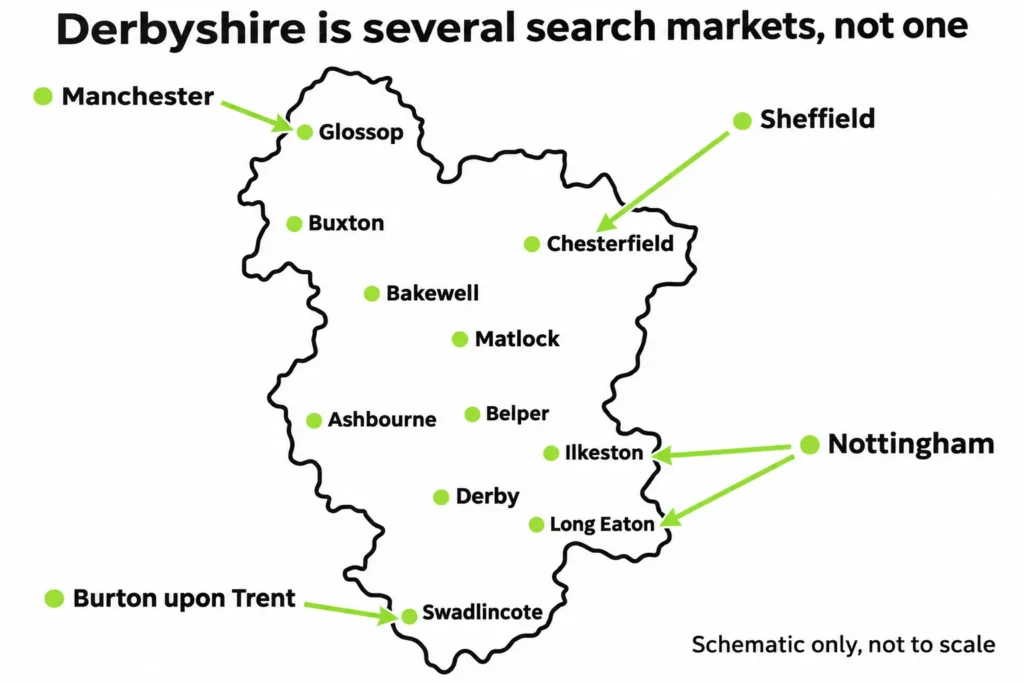
Every edge of the county faces a different city. Glossop and New Mills look towards Manchester. Dronfield sits on Sheffield’s doorstep. Long Eaton and Ilkeston are tied to Nottingham, and Swadlincote to Burton upon Trent. In those towns your competition in the search results is often a city business from over the county line, with more reviews and more links than a local firm.
The towns are far enough apart to matter. Buxton, Matlock, Chesterfield and Ashbourne are separate places with their own search results. Being well known in one does not carry over to the next.
This is why Derbyshire SEO has to be planned town by town, not as one county-wide campaign.
What the map results can and cannot do for a county-wide business
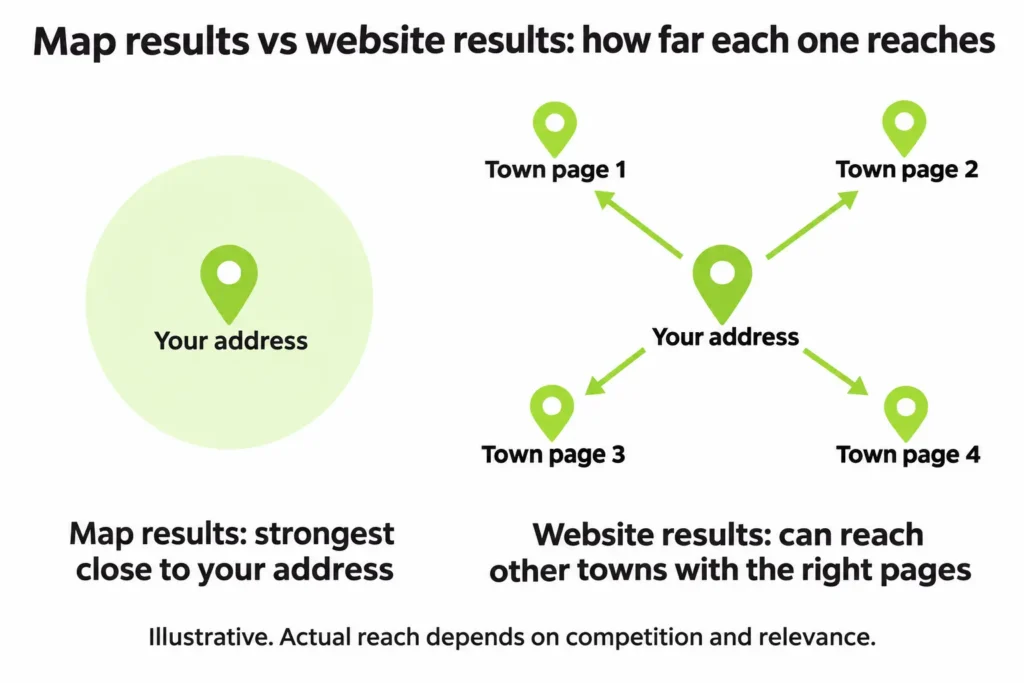
The box of three businesses with a map at the top of a local search is where most owners want to be. It is also the part of Google that reaches the shortest distance.
Google names three factors for local rankings: relevance, distance and prominence. They are set out in Google’s local ranking guidance. Distance is the one that catches county-wide businesses out. Google judges it from where your business is based and where the searcher is standing, so a firm with one address in Chesterfield is a weak candidate for the map results in Buxton, however good its website is.
Two things follow from that.
Listing more towns as service areas does not extend your reach. You can tell Google which areas you cover on your Business Profile, and you should, because it helps customers. In practice it does not move your map position in those towns. Google still works from where you are based.
The other towns are won in the ordinary results. Below the map sit the standard website listings. Those are not tied to your address in the same way. A useful, specific page about your service in Matlock can rank there even when your office is in Chesterfield. For a business with one address, this is where county-wide visibility comes from.
Your home town map position still deserves attention, and reviews carry much of it. In BrightLocal’s 2026 consumer review survey of US adults, 74% said they only care about reviews written in the last three months, and 47% said they would not use a business with fewer than 20 reviews. I would expect UK customers to be no more forgiving. A profile full of praise from 2023 is not doing the job it used to.
If your home town listing has slipped as well, start with the listing mistakes that cost map visibility. Fixing those is usually the first part of any map and local visibility work I take on.
Where is your visibility actually breaking?
Before changing anything, I work out which of these situations a business is in. Each one needs a different fix.
Google Search Console tells me most of this. Filtering search queries by town name shows exactly where a site is seen and where it is not. If visits are healthy and the phone is still quiet, the issue is why visits do not turn into enquiries, and no amount of ranking work will fix that.
Why one page per town with the name swapped does not work
The usual response to this problem is forty location pages: the same paragraph forty times, with Ilkeston, Heanor, Ripley and Alfreton swapped in. I see these on a lot of trade and service websites. They rarely rank, and a large set of near-identical pages can drag down how Google sees the rest of the site.
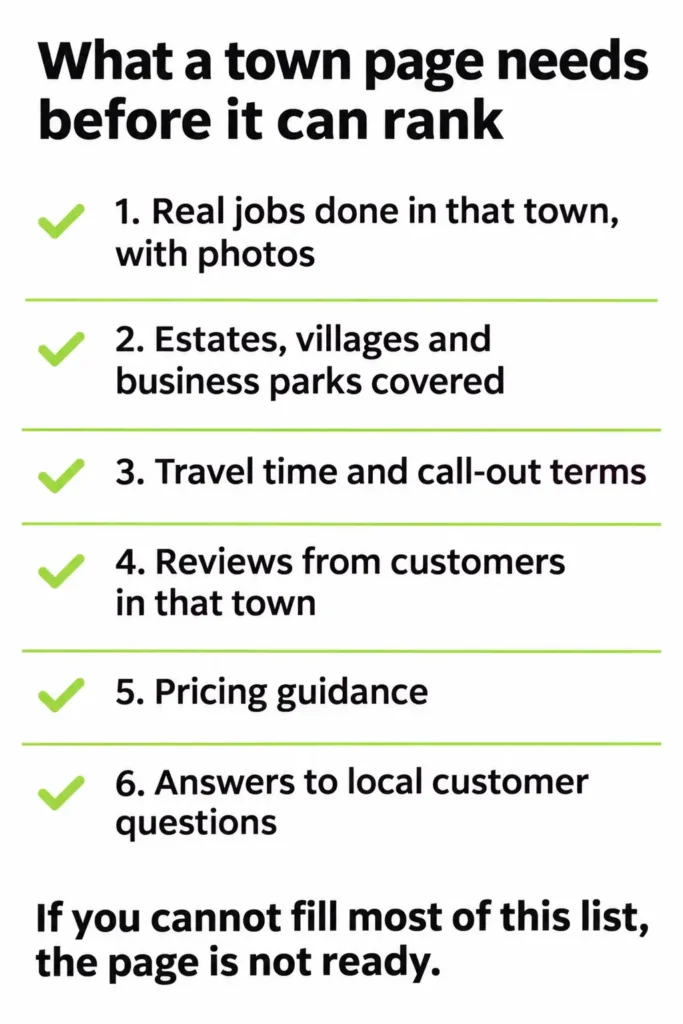
A town page earns its place when it tells a customer in that town something the other pages do not:
- Jobs you have actually done there, with photographs.
- The estates, villages or business parks you cover around it.
- How quickly you can get there and any call-out terms that apply.
- Reviews from customers in that town.
- Pricing guidance where you can give it.
- Answers to the questions customers there really ask.
If you cannot fill most of that list for a town, the page is not ready to exist. Start with the three to five towns that already send you work. A few strong pages will beat forty thin ones.
If your site already has dozens of these pages, do not delete them blindly. Some may be bringing in visits. Here is how to tell which pages are helping and which are holding you back before you remove anything.
The pages also need to be reachable. A town page buried three clicks deep, linked from nowhere but the footer, tells Google it does not matter. I cover how the links between your own pages decide what ranks in a separate guide.
Derby is a different fight
Derby is the largest single market in the area, and the most competitive. More businesses are chasing the same searches, many of them based inside the city with years of reviews behind them.
If you are based in Derby, the city is your home market and your map position there is worth real effort. If you are based in Belper, Ripley or Swadlincote, be realistic. You are unlikely to hold a place in Derby’s map results from outside the city. A strong Derby page can still win website results there, but it should be a deliberate choice. Decide whether Derby work is worth the travel and the competition before you put time into it.
If you rely on Peak District visitors, the calendar matters as much as the map
Hospitality, holiday lets, outdoor activities and attractions have a different problem from trades. Their customers are mostly not in Derbyshire when they search.
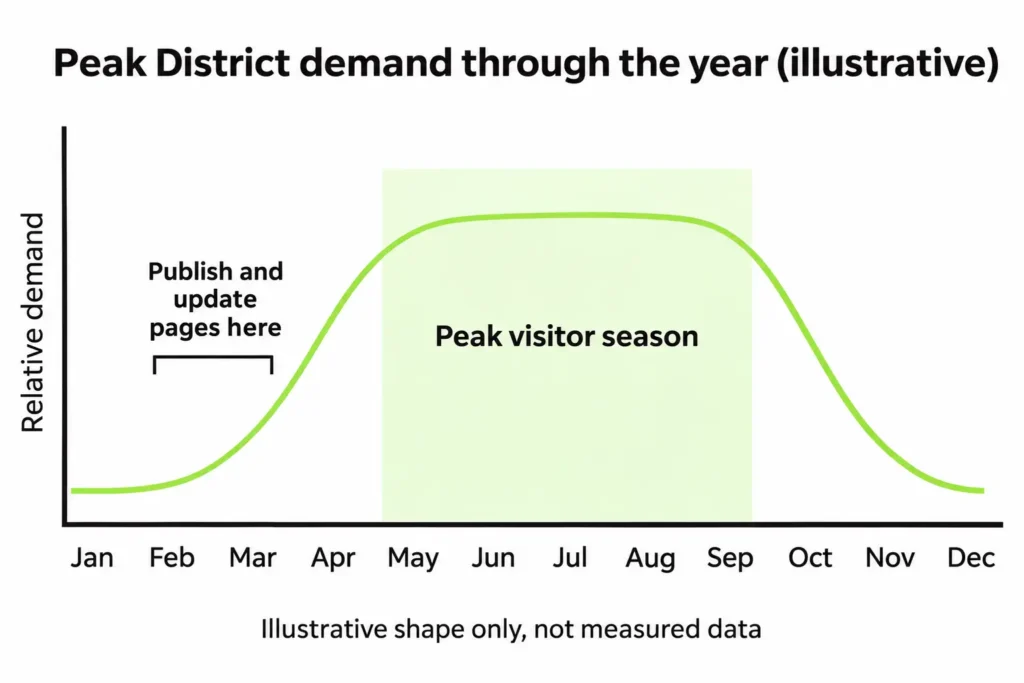
The Peak District National Park Authority’s State of the Park report estimates between 13 million and 26 million visitors a year, with numbers peaking from May to September. Those visitors plan from Manchester, Sheffield, Nottingham and much further away, weeks or months before they travel.
That changes what good SEO looks like:
- You need to rank for searches made outside the county. The map results near your address matter less than the website results people see while planning at home.
- Pages need to be live well before the season. A page published in June is too late for people who booked in March.
- Autumn drops are normal. A fall in visits every October is usually demand, not damage. Search Console keeps 16 months of data, so compare this year with the same weeks last year before you assume something broke.
I explain how I read seasonal demand before planning content in another post. For a visitor-led business it is the first thing I look at.
The order I would fix a county-wide site in
I do not start with a list of new keywords. I start by finding out where the business is already seen and where enquiries really come from.
- Confirm where your work comes from. Go through recent jobs town by town. The towns that already send you customers are the ones to build on first.
- Fix the home listing and the page it points to. Categories, opening hours, recent reviews, and a landing page that matches what the profile says you do.
- Check the site can be crawled and indexed properly. There is no point building pages Google cannot reach. These are the technical checks I run first, and where they turn up problems, crawl and indexing fixes come before anything else.
- Get the main service pages right. Each service needs one clear page before any town pages are added. That usually means rebuilding pages around what customers actually search.
- Build three to five town pages properly. Use the checklist above, and link them from the service pages and the main navigation.
- Measure by town. Track impressions, clicks and enquiries for each town separately, so you can see which pages are earning their keep.
Some of this shows results within weeks, particularly technical fixes on an established site. New town pages usually take a few months to settle, depending on how strong the competition is in each place.
Choosing SEO help in Derbyshire
Search for SEO Derbyshire and you will mostly find agency location pages and directory lists. Several of those agencies are based outside the county and have a Derbyshire page alongside pages for every other county they sell to. That is not a problem in itself. I work remotely too, and I say so. The problem is paying for a local plan that is the same template with the place name changed.
| Derbyshire-based agency | Out-of-county agency with a Derbyshire page | Independent consultant (how I work) | |
|---|---|---|---|
| Who does the work | A local team, often small | An account team following a set process | The person you speak to |
| Local presence | An office in Derby, Chesterfield or nearby | Usually none in the county | None. I work remotely and say so |
| How you pay | Monthly retainer, often with a minimum term | Monthly retainer, often with a longer contract | $25 to $49 an hour, projects from $1,000 |
| Best for | Face-to-face meetings and wider marketing support | Larger or multi-site brands | Finding why visibility stops at the edge of town and fixing it |
| Watch out for | Junior staff doing the actual work | The same plan sold in every county | Limited capacity for bulk content production |
Whoever you speak to, ask them three things. Which towns will you target first, and why those? How will you show me results town by town? What would you not do for a business like mine?
A provider who answers with a fixed list of monthly deliverables before looking at your site is selling a standard package with a custom label. If you are still weighing an agency against an independent specialist, I have covered that choice separately.
I do not have an office in Derbyshire and I will not pretend to. I can audit and improve your website and your Business Profile from anywhere. What I cannot change is where your business is based, and I would be wary of anyone who promises you a map position in a town you do not operate from.
Frequently asked questions about SEO in Derbyshire
Can I rank in several Derbyshire towns with one address?
Yes, but mostly in the website results below the map. The map results favour businesses close to the searcher, so one address will not hold map positions across the county. Well-built pages for the towns you serve can rank in the standard results in each of them.
Do I need a separate page for every town in Derbyshire?
No. A page for every town with only the name changed rarely ranks and can weaken the whole site. Build pages only for towns where you do real work and have something specific to say, starting with three to five.
How much do SEO services in Derbyshire cost?
It depends on how many towns and services you need to cover and the condition of your website. My own work is billed at $25 to $49 an hour, with most projects starting from $1,000. When the problem has a clear cause, a focused audit is often better value than a monthly retainer. I break down what SEO usually costs in a separate guide.
How long does SEO take to work for a Derbyshire business?
Technical fixes on an established site can show within weeks. New town pages usually need a few months, and competitive places such as Derby or Chesterfield take longer than smaller towns. Be wary of anyone promising first-page results within a month.
Should I hire an SEO agency based in Derbyshire?
Local knowledge helps, but it matters less than whether the provider can diagnose your site and explain their plan. Plenty of good work is done remotely. Judge the plan, the person doing the work and how results will be reported, not the postcode.
My traffic suddenly dropped. Is that the same problem?
Probably not. This guide covers visibility that never reached beyond your home town. A sudden fall on a site that used to rank well is a separate job, and diagnosing a drop starts with what changed and when.
What clients say
“Muhammad is very talented person and knows his stuff. He found issues that many people missed.”
Zack Oughriss, Business owner
“Muhammad delivered excellent work on this SEO and optimization project, and I truly enjoyed working with him. Over the course of our 8-month collaboration, his strategies led to over 400% increase in customer leads – helping us outperform even larger competitors in our saturated industry.”
Alessio Ligabue, Services Provider (Italy)
Find out where your Derbyshire visibility stops
If your business is seen in one town and missed in the rest, I can show you exactly where the line falls and why.
In a free 1:1 strategy call, I will look at your site and your search data, show you which towns you are visible in today, and tell you what I would fix first. You get clear next steps, with no ranking guarantees and no pressure to buy work you do not need.